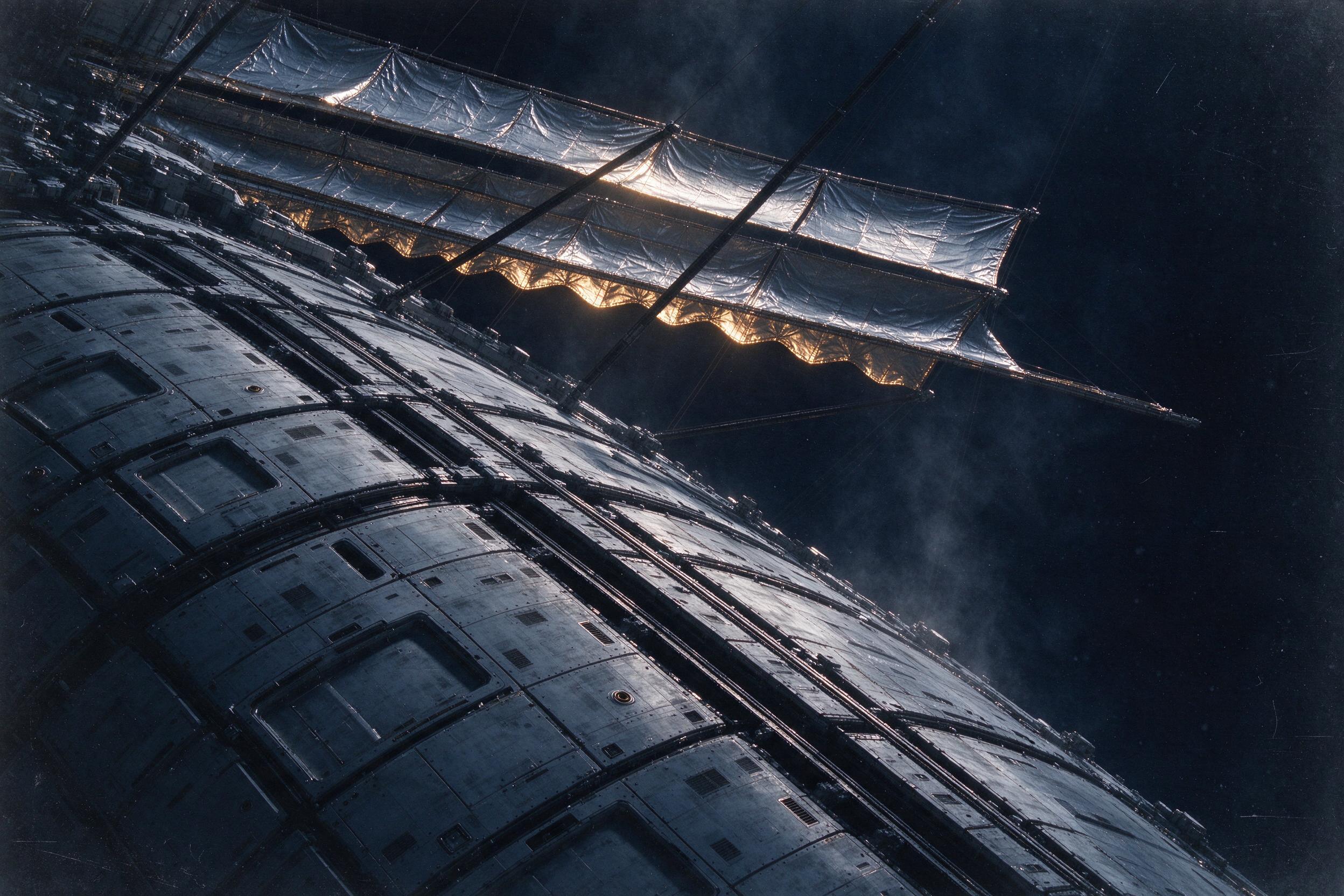
太空里没有空气,热只能靠辐射一点点甩出去。马斯克说这很容易,一位教授说根本不可能。两个人都没错——但他们漏掉了同一件事。There is no air in space, so heat can only leave by radiation. Musk says that is easy. A professor says it is impossible. Both are right — and both miss the same thing.
这两个人说的是一件事的两头,都对,也都停在同一个地方:把热当成废物,只想怎么扔。这篇把他们漏掉的那一层补上,并且算到底。算完会得到一个反直觉的结论——决定空间站做多大的,不是散热,是发电。On 2–3 November 2026 the two argued on X for 48 hours. The professor said a vacuum is the best insulator we have, and that space data centres are “extremely unlikely to ever happen”. Musk answered with a personal insult and a number: an aluminium radiator facing away from the Sun sheds 1,300 W/m².
This piece picks up the arithmetic where they stopped: for a 10 MW station, where the heat actually goes, how large the station has to be, what it costs, and when any of it becomes real. The answer is counter-intuitive — what sets the size of a space station is not cooling. It is generation.
1,300W/m²马斯克给的数。我们复核过:成立,但没有任何余量Musk’s number. We checked it: it holds, with zero margin
43,700m²一座 10 MW 站要铺的太阳能板,是散热板的 3.6 倍Solar area for a 10 MW station: 3.6× the radiator
×25五年里 AI 机柜的功率涨幅。同期排热能力只涨 1.4 倍AI rack power, five years. Rejection grew 1.4× in the same time
Figures and tables are kept in the original Chinese so that technical labels and units stay exact.
部一问题Part IThe Problem
01这份文件是什么What this is
它不是设计,也不是期刊投稿。它想回答一个问题:It is not a design document, and it is not a journal submission. It tries to answer one question:
当所有人都同意「太空只能靠辐射散热」之后,为什么还有人说「辐射是最差的那一招」?
Everyone now agrees that space can only dispose of heat by radiation. So why would anyone call radiation the worst option we have?
答案是:因为一座站不是一块板。 一块板只能辐射;一座站可以在内部把热搬来搬去、存起来、抬高温位、交给产品带走,辐射只负责收尾。Because a station is not a panel. A panel can only radiate. A station can move heat around inside itself, store it, lift its temperature, and hand it to a product on the way out. Radiation only handles the last step.
本文件做三件事:This document does three things:
给出一条不同于「大 vs 小」的架构线:三区分离;an architectural line that is not the usual “big versus small”: three separate zones;
给出可复算的账:面积、质量、能量收支;an auditable ledger: area, mass, energy balance;
明确说出这套论证会在哪里被推翻。a plain statement of where this argument breaks.
an architectural line that is not the usual 'big versus small': three separate zones;
an auditable ledger: area, mass, energy balance;
a plain statement of where this argument breaks.
1.1读法How to read it
图 14|全文地图:七个部分Fig. 14 — Map of the whole piece: seven parts
如果你只有五分钟:读 04(决定尺寸的是发电)、07(四个数量级)、09(三区)、20(客户是地外)、30(结语)。If you have five minutes: read 04 (size is set by generation, not cooling), 07 (four orders of magnitude), 09 (the three zones), 20 (the customer is off-world), and 30 (closing).
还有一条,写在最前面:本文的判据是「可不可行」,不是「划不划算」。One more thing, stated up front: the test here is feasibility, not cost.
这不是商业计划书。所以每个环节的判断标准是「能不能做到」,不是「赚不赚钱」。成本高的方案只要物理上成立,就留在选项里;只有「物理上做不到」才被划掉。价格只影响先后顺序,不影响方向。This is not a business plan. Every decision is judged by whether it can be done, not by whether it pays. An expensive option stays on the list as long as the physics allows it; only physics can strike something out. Price changes the order, never the direction.
02由头:两个都不完整的答案The quarrel: two incomplete answers
2026 年 11 月 2 日至 3 日,两位在 X 上交锋。On 2 and 3 November 2026, two people argued on X.
J. Broersen(乌得勒支大学,AI 中的逻辑方法讲席教授):"真空是人类能找到的最好的隔热层……这些太空数据中心极不可能实现,在我们有生之年肯定不行。"J. Broersen (Utrecht University, professor of logic-based methods in AI): "A vacuum is the best insulator human beings can produce... these space data centres are extremely unlikely to ever happen, and certainly not in our lifetimes."
E. Musk(11 月 2 日晚):"背向太阳的铝制散热器,1,300 W/m² 不难。光伏大约 250 W/m²,所以帆板面积大约是辐射面积的 5 倍。"E. Musk (evening of 2 November): "An aluminium radiator pointed away from the Sun does 1,300 W/m². Panels do about 250 W/m², so the array is roughly five times the radiator area. Not difficult."
三件事都是事实:All three claims are facts:
真空确实是已知最好的隔热层,但它只管辖站壳那最后一米(第 5 节)。A vacuum really is the best insulator we have, but it governs only the last metre of the hull (§5).
1,300 W/m² 这个数成立,我复核过:对应 82 °C 双面或 124 °C 单面,没有余量。1,300 W/m² holds; I checked it. It corresponds to 82 °C two-sided or 124 °C one-sided, with no margin.
光伏面积确实是辐射面积的数倍:而这句话本身就是本文的入口。The array really is several times the radiator area, and that sentence is the way into this piece.
A vacuum really is the best insulator we have, but it governs only the last metre of the hull (section 5).
1,300 W/m² is real; we checked it. It corresponds to 82 °C two-sided or 124 °C one-sided, with no margin.
The array really is several times the radiator area, and that sentence is the way into this document.
两位都对了一半。Broersen 错在从「没有介质」跳到「没有出路」;Musk 错在把「能排」当成了「该排」。Both are half right. Broersen's error is jumping from 'there is no medium' to 'there is no way out'. Musk's error is treating 'it can be dumped' as 'it should be dumped'.
03尺子:先把三个数钉住The rulers: pin three numbers first
后文所有面积都从这三个数出。口径写死,方便任何人复算。Every area in this document follows from these three numbers. The conventions are fixed so anyone can redo the arithmetic.
辐射净排热(双面、ε = 0.92、550 km 轨道、扣除地球红外与反照约 22.4%)Net radiative rejection (two-sided, ε = 0.92, 550 km orbit, Earth IR and albedo subtracted, about 22.4%)
出口温度Outlet temperature
净排热Net rejection
10 MW 需要的面积Area required for 10 MW
45 °C
830 W/m²
12,055 m²(1.21 ha)
75 °C
1,190 W/m²
8,407 m²
82 °C
1,288 W/m²
7,764 m²
120 °C
1,934 W/m²
5,170 m²
400 °C
16,624 W/m²
602 m²
500 °C
28,930 W/m²
346 m²
800 °C
107,382 W/m²
93 m²
比质量(同一个物理问题,差 26 倍,这是整场争论真正的战场)Specific mass (the same physics, a 26× spread, and the real battlefield of this argument)
技术Technology
比质量Specific mass
ISS 氨热管辐射器(遗产)ISS ammonia heat-pipe radiator (legacy)
≈5 kg/m²(约 13 W/kg)≈5 kg/m² (about 13 W/kg)
碳纤维复合板Carbon-fibre composite panel
2.4–3.6 kg/m²(163–346 W/kg)
先进复合材料(预测)Advanced composites (projected)
~2 kg/m²
液滴辐射器(LDR)Liquid droplet radiator (LDR)
理论可比管翅式轻一个数量级(<1 kg/m²)Theoretically an order of magnitude lighter than tube-and-fin (<1 kg/m²)
温度:每抬 30 °C,面积减三成。每抬一个量级,面积减两个量级。Temperature: every 30 °C cuts the area by a third. Every order of magnitude cuts it by two.
04反常识:决定站有多大的是发电,不是散热The counter-intuitive part: size is set by generation, not cooling
这是本文与现有讨论最大的分歧点。This is where this document parts company with the existing discussion.
光伏面积是散热面积的 3.6 倍。The photovoltaic area is 3.6 times the radiator area.
用 Musk 自己的口径算更狠:1,300 ÷ 250 = 5.2 倍。他自己给出了这个比例,却没有走到下一步。Using Musk's own figures it is worse: 1,300 ÷ 250 = 5.2×. He produced this ratio himself and did not take the next step.
4.1真正的变量是什么So what is the real variable
整场「太空散热难不难」的争论,争的是第二大的那块面积。The whole argument about whether cooling in orbit is hard is about the second-largest area, not the largest.
如果辐射比质量能从 3.6 kg/m² 降到 1.0,散热面积的成本降 3.6 倍,但光伏面积一分都不会动。Drop radiator specific mass from 3.6 to 1.0 kg/m² and cooling cost falls 3.6×, while the array does not move at all.
如果温度从 45 °C 抬到 120 °C,散热面积降 2.3 倍,光伏面积一分都不会动。Raise the loop from 45 °C to 120 °C and the radiator shrinks 2.3×, while the array does not move at all.
反过来,只要提高光伏效率 10%,省下的面积相当于把散热问题解决三分之一。Conversely, a 10% gain in array efficiency saves as much area as solving a third of the cooling problem.
Drop the radiator's specific mass from 3.6 to 1.0 kg/m² and cooling cost falls 3.6×, while the array does not move at all.
Raise the loop from 45 °C to 120 °C and the radiator shrinks 2.3×, while the array does not move at all.
Improve panel efficiency by 10% and the area saved is worth a third of the cooling problem.
所以「太空数据中心卡在散热上」这个前提,对光伏供电的站来说是错的。它卡在发电面积上。So the premise that space data centres are stuck on cooling is wrong for a solar-powered station. They are stuck on generation area.
这一步推下去,结论只有一个:要解绑面积,只能上核电。 而核电还附赠一个红利:它的废热在 700–900 K,那个温度下 10 MW 的热只要 93–346 m²:比发电面积小两个数量级。Push that one step further and only one conclusion survives: to decouple power from area, you need nuclear. And nuclear throws in a bonus. Its waste heat sits at 700–900 K, where 10 MW of heat needs only 93–346 m²: two orders of magnitude less than the array.
上核能,一箭双雕:解绑发电面积,同时让散热从「难题」变成「小数」。 这是本文支持核电源的第一条理由,比「能源稳定」硬得多。Nuclear does two jobs at once: it unhooks power from surface area, and it turns cooling from a hard problem into a small one. That is the first reason this document takes nuclear seriously, and it is a much harder reason than 'energy security'.
4.2面积账的完整版The full area ledger
部分Item
面积Area
质量(估)Mass (estimate)
备注Note
光伏阵列Photovoltaic array
43,700 m²
66–127 t
2.9 kg/m²(ISS SAW 级)到 1.5 kg/m²(先进柔性)2.9 kg/m² (ISS SAW class) down to 1.5 kg/m² (advanced flexible)
辐射板(45 °C)Radiator (45 °C)
12,055 m²
29–43 t
2.4–3.6 kg/m²
辐射板(含工艺热)Radiator (including process heat)
≈5,400 m²
13–19 t
见第 5、10 节See §5 and §10
合计(光伏路线)Total (solar route)
≈5.6 ha
≈110–190 t
未含结构、回路、储热Excludes structure, loops, storage
这一节是本文的题眼:尺寸不是被散热逼出来的,是被发电逼出来的。散热只是让尺寸变得更贵。
This section is the hinge of the whole argument: the size is not forced by cooling. It is forced by generation. Cooling only makes that size more expensive.
部二物理Part IIPhysics
05真空不是绝缘体:三个尺度,六条路Vacuum is not an insulator: three scales, six routes
Broersen 说「真空是最好的隔热层」。成立:但只管辖站壳那最后一米。Broersen is right that a vacuum is the best insulator we have. He is also right only about the last metre of the hull.
环节Stage
换热系数Heat transfer coefficient
站内液体单相对流Single-phase liquid convection inside the station
1,000–10,000 W/m²K
站内两相(沸腾/冷凝)Two-phase inside the station (boiling/condensing)
≈2.2 W/m²K(348 K 对 4 K 背景)≈2.2 W/m²K (348 K against a 4 K background)
差 2–4 个数量级。That is a spread of two to four orders of magnitude.
也就是说:热从芯片出来,到辐射板之前,完全可以在跟地面工厂一样的效率下被搬运、被分配、被提温。真空只在最后交接给深空的那一步起作用。Which means: between the chip and the radiator panel, heat can be moved, split, stored and lifted at the same efficiency as in a ground plant. The vacuum only matters at the final handover to deep space.
这条区分是本文全部架构的物理基础:This distinction is the physical basis of everything that follows:
Cooling in space is not hard because heat cannot travel. It is hard because the last interface is a surface, and surface is bought with space, time and temperature. Those three together are the three zones in section 9.
5.1三个尺度:机制在哪里切换Three scales: where the mechanism changes
图 8|真空的三种尺度:换热机制在哪里切换Fig. 8 — Three scales of vacuum: where the mechanism changes
维恩波长 λ ≈ 2898 / T(μm):300 K 时 9.7 μm,100 K 时 29 μm。间隙小于 λ 才出现近场增强:深冷区的近场效应在更大的间隙上就开始了。Wien wavelength λ ≈ 2898/T (μm): 9.7 μm at 300 K, 29 μm at 100 K. Near-field enhancement only appears below that gap, so a cold zone starts benefiting at larger gaps.
克努森数 Kn = λ_mean / L:太空残余气体在 10⁻⁶ Pa 下分子自由程是公里级,所以站内任何间隙都满足 Kn ≫ 1。「流体」这个词在真空边界不存在,只有「分子撞板」。Knudsen number Kn = λ_mean/L. At 10⁻⁶ Pa the mean free path is kilometres, so every gap inside the station satisfies Kn ≫ 1. The word “fluid” does not exist at a vacuum boundary — only molecules hitting a plate.
Wien wavelength λ ≈ 2898/T (μm): 9.7 μm at 300 K, 29 μm at 100 K. Near-field enhancement appears only below that gap, so the cold zone starts benefiting at larger gaps.
Knudsen number Kn = λ_mean/L. At 10⁻⁶ Pa the mean free path is kilometres, so every gap inside the station satisfies Kn ≫ 1. The word 'fluid' does not exist at a vacuum boundary.
所以地面对流换热公式在太空边界全部失效。这不是精度问题,是范式问题。太空热管理必须用分子动理论和辐射传热,而不是 h = Nu·k/L。
Which is why every ground convection formula fails at the boundary. This is not a matter of accuracy; it is a different regime. Space thermal design has to use kinetic theory and radiative transfer, not h = Nu·k/L.
06热值多少钱:㶲What heat is worth: exergy
前面所有「换温度」的直觉,都可以收进一个量:㶲(exergy)。Every intuition about 'changing the temperature' collapses into one quantity: exergy.
㶲 = Q · (1 − T₀ / T) T₀ 取 300 K
Exergy = Q · (1 − T₀ / T), with T₀ taken as 300 K
它衡量的是:这份热里,有多少是可以变成功的。剩下的部分叫「㶲损」,只能排掉。It measures how much of that heat can still become work. The rest is destroyed exergy, and it can only be dumped.
6.1一张表把直觉变成定理One table turns intuition into a theorem
温度Temperature
㶲效率Exergy efficiency
10 MW 值多少「功」Work value of 10 MW
10 MW 直接排要多大面积Area needed to reject 10 MW directly
45 °C
5.7 %
0.57 MW
12,055 m²
75 °C
13.8 %
1.38 MW
8,407 m²
120 °C
23.7 %
2.37 MW
5,170 m²
400 °C
55.4 %
5.54 MW
602 m²
700 °C
69.2 %
6.92 MW
514 m²
同样 10 MW 的热,45 °C 只值 0.57 MW 的功,700 °C 值 6.92 MW,差 12 倍。The same 10 MW is worth 0.57 MW of work at 45 °C and 6.92 MW at 700 °C. A factor of twelve.
图 10|㶲:同一瓦热,温度决定它值多少钱Fig. 10 — Exergy: the same watt of heat is worth whatever its temperature says
6.2两条曲线决定一切Two curves decide everything
成本曲线:辐射面积 ∝ 1/T⁴,按温度的四次方收费;Cost curve: radiator area ∝ 1/T⁴ — you are charged by the fourth power of temperature;
价值曲线:㶲 ∝ 1 − T₀/T,只按温度的一次方计价。Value curve: exergy ∝ 1 − T₀/T — you are paid by the first power only.
一套热架构的全部设计,就是让热尽量待在两条曲线的交点右侧工作。 左边(低温)是「面积贵、价值低」的双输区,右边(高温)是「面积便宜、价值高」的双赢区。三区架构做的所有事,分流、缓存、提温、工艺热:都只是把热往右边推。The entire design of a thermal architecture is keeping the heat to the right of where those two curves cross. To the left, area is expensive and value is low: both lose. To the right, area is cheap and value is high: both win. Everything the three-zone architecture does, splitting, buffering, lifting, process heat, is only pushing heat to the right.
6.3转电什么时候划算:面积套利When converting heat back to electricity pays: area arbitrage
一定要分清:转电不是散热手段,是产能手段。One distinction has to be made: conversion is not a cooling method. It is a generation method.
它必然让散热更贵,因为转完电,剩下的热温度更低。所以判据不是「效率多高」,而是「这块电,值不值得那块多出来的面积」。It always makes cooling more expensive, because the heat that remains is colder. So the test is not efficiency. The test is whether that electricity is worth the extra area it costs.
热源Heat source
器件Device
效率Efficiency
拿到的电Electricity obtained
面积变化Change in area
结论Verdict
45 °C
—
卡诺上限 5.7 %Carnot limit 5.7%
≈0
—
永远不划算Never pays
400 °C
斯特林Stirling
25–35 %
2.5–3.5 MW
排热降到 300 °C,面积反而增Rejection drops to 300 °C — area grows instead
看电值多少Depends on what the electricity is worth
1180 K(核堆)1180 K (reactor)
AMTEC
16 % 实测(NASA:转换器 1180 K / 辐射器 711 K)16% measured (NASA: converter 1180 K / radiator 711 K)
1.6 MW
64 → 406 m²
面积套利 20 倍20× area arbitrage
700 K
AMTEC
门槛之下Below threshold
极少Very little
—
不适用Not applicable
最后一行是本文的关键一笔:The last row is the key line of this document:
342 m² of radiator buys 1.6 MW of electricity. Getting that 1.6 MW from solar would take 7,000 m². Twenty times cheaper.
所以「热转电」的判据只有一条:它换掉的是哪块面积。 低温热转电是纯亏,高温热转电是套利。So there is exactly one test for converting heat to electricity: which area does it replace. Cold heat is a straight loss. Hot heat is arbitrage.
而三区架构里天然满足 900–1300 K 的热源只有一个:核反应堆的冷却剂。 这是「上核电」的第二条理由(第一条是解绑发电面积,见第 4 节):核能不只是能源,它还是本文唯一的高温㶲来源。In the three-zone architecture, the only source that naturally sits at 900–1300 K is the reactor coolant. That is the second reason to go nuclear, after decoupling generation from area: nuclear is not just an energy source, it is the only high-temperature exergy this design has.
07从芯片到深空:四个数量级From the die to deep space: four orders of magnitude
这一节是全篇的物理骨架,也是前一版最大的缺口。This section is the physical spine of the document, and the largest gap in the previous draft.
前面我一直用「45–75 °C 回水」在算账,那是数据中心的平均值,不是热源的真实状态。真正的热源在芯片里,而 AI 机柜的功率密度已经不是「机房」的量级:Everything above was calculated on a 45–75 °C return loop. That is a data-centre average, not the state of the source. The real source is inside the chip, and an AI rack is no longer built on data-centre scale:
图 11|从芯片到深空:四个数量级的界面链Fig. 11 — From die to deep space: a four-order-of-magnitude chain of interfaces
层级Level
热流密度Heat flux
依据Basis
界面技术Interface technology
芯片 dieChip die
600 → 850 W/cm²
B200 单 die 约 600;B300 ≈1,400 W/GPU,单 die 更高;Grace CPU ≈330B200 single die about 600; B300 ≈1,400 W/GPU, higher per die; Grace CPU ≈330
So a cooling system is never a panel. It is a five-stage chain of interfaces, each one spreading the flux tenfold and multiplying the area by ten. If any stage fails, a bigger panel downstream changes nothing.
这解释了一个反直觉的事实:辐射板面积大 ≠ 散热容易。 你完全可能有一块 12,000 m² 的板,却卡死在 600 W/cm² 那一层,因为芯片先烧穿,板还没热起来。Which explains a counter-intuitive fact: a large radiator does not mean easy cooling. You can have 12,000 m² of panel and still be stuck at the 600 W/cm² layer, because the die burns through long before the panel warms up.
7.1商业现实是反的:功率越高,要求的水越冷Commercial reality runs the other way: more power demands colder water
我原以为可以把进水温度往上抬(温度高、面积小,两全其美)。但产业数据是反的:The assumption was that you could raise the supply temperature, getting small area and high temperature at once. The industry data says otherwise:
ASHRAE 液冷等级ASHRAE liquid-cooling class
设施供水温度Facility supply temperature
典型适用Typical use
W17
17 °C
高功率芯片,仍需冷机High-power chips; chiller still required
W27
27 °C
主流Mainstream
W32
32 °C
多数地区可无冷机Chiller-free in most regions
W40
40 °C
新增,为高密度补位Newer class, added for high density
W45
45 °C
无冷机 / 干冷器Chiller-free / dry cooler
行业还观察到:当 GPU 功率上到 500–700 W 以上时,案例温度反而要求水更冷。W17 比 W27 更受青睐。原因就是那一条:Tj = T_in + R_th × Q。Q 涨了,只能靠降 T_in 守住结温。The industry also observes that above 500–700 W per GPU, case temperatures demand colder water, not warmer; W17 gets chosen over W27. The reason is the equation: Tj = T_in + R_th × Q. When Q rises, the only way to hold the junction temperature is to drop T_in.
这直接推翻一个常见想象:「芯片越来越热 → 排热温度越来越高 → 散热越来越容易」。 真实情况是:芯片越来越热 → 要求冷源越来越冷。 而冷源在太空是最稀缺的东西。Which overturns a common assumption: hotter chips mean hotter rejection and easier cooling. The opposite is true. Hotter chips demand a colder source, and a cold source is the scarcest thing in space.
7.2所以第一道坎不是「排热」,是「没有冷源」So the first obstacle is not rejection. It is the absence of a cold source
地面靠冷却塔和冷机提供 17–45 °C 的冷水,这是免费送的。太空四样都没有:没有大气、没有水、没有环境冷库、没有地下。On the ground, cooling towers and chillers hand you water at 17–45 °C for free. In orbit none of the four things exist: no atmosphere, no water, no ambient reservoir, no ground.
这就把「交换区」的另一半逼出来了:它不只是热端,它还是冷端:Which forces out the other half of the exchange zone. It is not only the hot end; it is also the cold end:
冷从哪来Where the cold comes from
手段Approach
能到多冷How cold
代价Cost
深空 3 K 背景3 K deep-space background
遮阳帆造出的冷区 + 低温辐射面Sunshield-made cold zone + low-temperature radiating surface
40–80 K(JWST 实测 40 K)40–80 K (JWST measured 40 K)
面积 + 遮阳结构Area + sunshield structure
相变储冷Phase-change cold storage
冰 / 冷媒Ice / refrigerant
相变点Phase-change point
用完要补Must be replenished
月冰Lunar ice
地月物流Cislunar logistics
273 K 级Around 273 K
运力Freight capacity
机械制冷Mechanical refrigeration
斯特林 / 蒸气压缩Stirling / vapour compression
任意Any
自己产热,净增负荷Generates its own heat — a net load increase
一句话:在太空,热要排出去,冷要买进来。 而买冷的账,地面是赠送的,太空是标价的。In one sentence: in space, heat must be pushed out and cold must be bought in. On the ground the cold is thrown in for free. In orbit it is priced.
7.3一个反直觉的结论:冷要用面积买,不要用电买A counter-intuitive result: buy cold with area, never with electricity
算一笔账。10 MW 算力,进水要 17–27 °C 这一档,两条路:Run the numbers. 10 MW of compute, supply temperature in the 17–27 °C band. Two routes:
方案Option
辐射板Radiator
制冷电耗Refrigeration power draw
电的光伏面积Solar area for that electricity
总「面积成本」Total “area cost”
A 直接低温辐射(板子 17 °C)A: direct low-temperature radiation (panel at 17 °C)
17,483 m²
0
0
17,483 m²
B 热泵提到 45 °C 再排B: heat pump to 45 °C, then reject
12,048 m²
1.9 MW(COP≈5.2)
8,297 m²
12,048 + 8,297 = 20,345 m²
B(含制冷自身产热)B (including the refrigeration's own heat)
In space, trading area for electricity loses, and trading electricity for area also loses, because electricity comes from solar and solar area is 3.6 times the radiator area and more expensive per square metre. The optimum is a large panel, low temperature, direct radiation, not a small panel, high temperature and a chiller.
这一条的推论很重要:能省的制冷一定要省。 制冷机在太空是一个「用电换温度」的机器,而太空的电最贵。这就是为什么第 10 节的「冷区」、第 14 节的「月冰」,比任何高级压缩机都值钱。The corollary matters: save every watt of refrigeration you can. A chiller in space is a machine that trades electricity for temperature, and electricity is the most expensive thing on board. Which is why the cold zone in section 10 and the lunar ice in section 14 are worth more than any compressor.
7.4趋势:五年 25 倍,而排热只涨 1.4 倍The trend: 25× in five years, while rejection grew 1.4×
这一节是整个论证的紧迫性来源。This is where the urgency comes from.
时间Time
平台Platform
机柜功率Rack power
相对 2022Relative to 2022
2022–23
HGX H100(Hopper)
30–40 kW
1×
2024–25
GB200 / GB300 NVL72
120–142 kW(单 GPU 1,000–1,400 W)120–142 kW (1,000–1,400 W per GPU)
3.5×
2026
VR200 NVL144(Rubin)
190–250 kW
6×
2027
Rubin Ultra「Kyber」
600–650 kW
16×
2028+
Feynman 代Feynman generation
1 MW 级1 MW class
25×
五年,25 倍。Five years. Twenty-five times.
与此同时,辐射板的比排热能力从 830 涨到 1,190 W/m²(把水温从 45 °C 抬到 75 °C):1.4 倍。Over the same period, the specific rejection of a radiator went from 830 to 1,190 W/m², by lifting the loop from 45 °C to 75 °C. A factor of 1.4.
Supply grew 25×, rejection grew 1.4×. The missing factor of eighteen can only be covered by area, temperature and time, and all three require the station to be large.
而且这不是某一家公司的路线图问题。只要算力的密度在涨,散热需求就在涨;而辐射的物理上限是死的。And this is not one company's roadmap problem. As long as compute density rises, cooling demand rises, while the physical ceiling of radiation does not move.
7.5同一座 10 MW 站,机柜数在缩水The same 10 MW station holds fewer and fewer racks
机柜功率Rack power
10 MW 能装几柜Racks per 10 MW
机柜级热流密度Rack-level heat flux
132 kW(GB300)
76 柜76 racks
2 W/cm²
600 kW(Kyber)
17 柜17 racks
10 W/cm²
1 MW(Feynman 代)1 MW (Feynman generation)
10 柜10 racks
17 W/cm²
站没有变小,是每一柜变成了一座小电厂。 连带三个后果:The station did not shrink. Each rack turned into a small power plant. Three consequences follow:
单柜热负荷涨 5–8 倍,冷板、CDU、歧管、泵全部重做;Heat load per rack rises 5–8×, so cold plates, CDUs, manifolds and pumps are all rebuilt;
储热和削峰的粒度从「几百柜平均」变成「十柜硬扛」,波动更难摊;Storage and peak shaving go from averaging hundreds of racks to a handful carrying it alone, so fluctuations are harder to spread;
「一柜烧穿」的损失从 1/76 变成 1/10。冗余成本直接翻几倍。The loss from one rack burning through goes from 1/76 to 1/10. Redundancy cost multiplies.
7.6Intel 那条路线,在太空反而更值钱Intel's route is worth more in space, not less
同一年,Intel 走的是相反方向:In the same year, Intel went the other way:
Xeon 7「Diamond Rapids」(2027):最多 256 个 P 核、1.28 GB 末级缓存、PCIe Gen6、500 W 级 TDP;Xeon 7 “Diamond Rapids” (2027): up to 256 P-cores, 1.28 GB last-level cache, PCIe Gen6, 500 W-class TDP;
Crescent Island:350 W 风冷推理卡、32 个 Xe3P 核、最高 480 GB LPDDR5X,官方定位就是「塞进现有风冷机房」。Crescent Island: a 350 W air-cooled inference card, 32 Xe3P cores, up to 480 GB LPDDR5X — officially positioned to drop into existing air-cooled halls.
两条路线都真实存在:一条把密度堆到 1 MW/柜,一条把功耗压到 350 W。Both routes are real: one pushes density to 1 MW per rack, the other pushes power down to 350 W.
而在太空,后者的价值被放大:In orbit, the second is worth more:
350 W 的芯片可以用被动辐射散热,不需要制冷机; 1 MW 的机柜必须直触液冷 + 泵 + 交换区,一套都不能少。
A 350 W chip can be cooled by passive radiation alone, with no chiller. A 1 MW rack requires direct liquid cooling, pumps and an exchange zone, with nothing optional.
所以太空站不会只装一种机器,它应该是两种算力的混合体:So a station will not carry one kind of machine. It should carry a mixture:
靠近交换区,管路最短Next to the exchange zone — shortest plumbing
吞吐型的(训练、批处理)Throughput-type (training, batch)
低功耗、被动散热Low power, passive cooling
铺在大面积向阳/背阴面上,允许热一点Spread across large sunlit/shaded surfaces; can run hotter
这顺带回答一个现实问题:太空数据中心不是「把地面机房搬上去」,而是「按太空的约束重新选机器」。Which answers a practical question: a space data centre is not a ground data centre moved upstairs. It is a different machine, chosen against different constraints.
08时间尺度:热管理是一套滤波器Time scales: thermal management is a filter bank
第二道断层在时间上。The second gap is in time.
图 12|时间尺度:热管理是一套滤波器Fig. 12 — Time scales: thermal management is a filter bank
时间尺度Time scale
波动来源Source of fluctuation
谁接住What absorbs it
需要多大How much is needed
≈10 ms
芯片自身热容Heat capacity of the die itself
硅片自己The silicon itself
—
1–10 s
负载跃变(AI 训练可在 100 ms 内从 30 % 跳到 100 %)Load step (AI training can jump from 30% to 100% in 100 ms)
冷板 + 回路液体热容Cold plate + loop fluid heat capacity
3 MW 跃变 × 1 s = 3 MJ ≈ 36 kg 当量水(ΔT 20 K)3 MW step × 1 s = 3 MJ ≈ 36 kg water equivalent (ΔT 20 K)
Storage is not there to save energy. It is there to shift phase, like a capacitor in a circuit, flattening the peaks and nothing else.
这是上一版最大的盲区:我只算了「35 分钟地影」一个尺度,把毫秒到秒的负载波动完全跳过了。而后者才是超频与压力测试工况下最容易烧芯片的那一段。This was the biggest blind spot of the previous draft: only the 35-minute eclipse was counted, and load swings from milliseconds to seconds were skipped entirely. Those are exactly the ones that burn a die during overclocking and stress testing.
部三架构Part IIIArchitecture
09三区架构The three-zone architecture
一座站按功能分成三个区。分区的依据不是「装什么」,是温度和时间尺度。第②区内部再按温度分成两段,生活段 20–25 °C、工作段 45–1,600 °C,所以全站是「三区、两个温带」,不是四区。A station is divided into three zones by function. The dividing line is not what goes inside but temperature and time scale. Zone 2 splits again by temperature, a living band at 20–25 °C and a working band at 45–1,600 °C, so the whole station is three zones and two temperature bands, not four zones.
图 1|一座站的剖面:三区、向阳面与背阳面、唯一的热出口Fig. 1 — Cross-section of a station: three zones, sunlit and shadow faces, and the single heat outlet
看图就懂:左边是太阳,顶上是光伏(第 ① 区,面向太阳);中间两个块(第 ② 区)都在产热,人住的 20–25 °C,算力的 45–75 °C,工艺的 600–1,600 °C;底下是第 ③ 区,把不同温度的热分流;右边那片深蓝是永阴面,永远照不到太阳,高温辐射板就装在那里。站体外壳上的小箭头,表示整站表面都在向外辐射。Read the figure left to right: the Sun on the left; photovoltaics on top (zone 1, facing the Sun); the two middle blocks (zone 2) both generate heat, people at 20–25 °C, compute at 45–75 °C, process heat at 600–1,600 °C; zone 3 at the bottom splits heat by temperature; and the dark blue field on the right is the permanent shadow face, never lit, where the high-temperature radiators sit. The small arrows on the hull show that the whole outer surface radiates.
三个区之间只走两条线:电和热。 别的都是次要的。Only two things cross between zones: electricity and heat. Everything else is secondary.
9.1为什么必须这样分Why the split is necessary
生活区和工作区分开,因为它们要的温度不一样:人 20–25 °C,工艺 600–1,600 °C。放在一个区里,等于让空调去冷却冶炼炉的邻居。Living and working zones are separate because they need different temperatures: people at 20–25 °C, process heat at 600–1,600 °C. Put them in one zone and you are asking an air conditioner to cool a furnace's neighbour.
交换区是枢纽,不是处理厂。它不生产、不消耗,它只决定每一瓦热去哪。叫它「散热区」没错,但它的活儿是调度,不是排放。The exchange zone is a switchboard, not a treatment plant. It neither produces nor consumes; it only decides where each watt goes. Calling it the “cooling zone” is not wrong, but its job is dispatch, not dumping.
只有三区分离,才有「热总线」这个东西。混在一起,热就只能就近排掉。Without the split there is no such thing as a heat bus. Mixed together, heat can only be dumped where it happens to be.
They run at different temperatures. People need 20–25 °C; process heat needs 600–1,600 °C. Put them in one zone and you are asking an air conditioner to cool a furnace's neighbour.
The exchange zone is a switchboard, not a treatment plant. It neither produces nor consumes; it decides where each watt goes.
Without the split there is no such thing as a heat bus. Mixed together, heat can only be dumped where it happens to be.
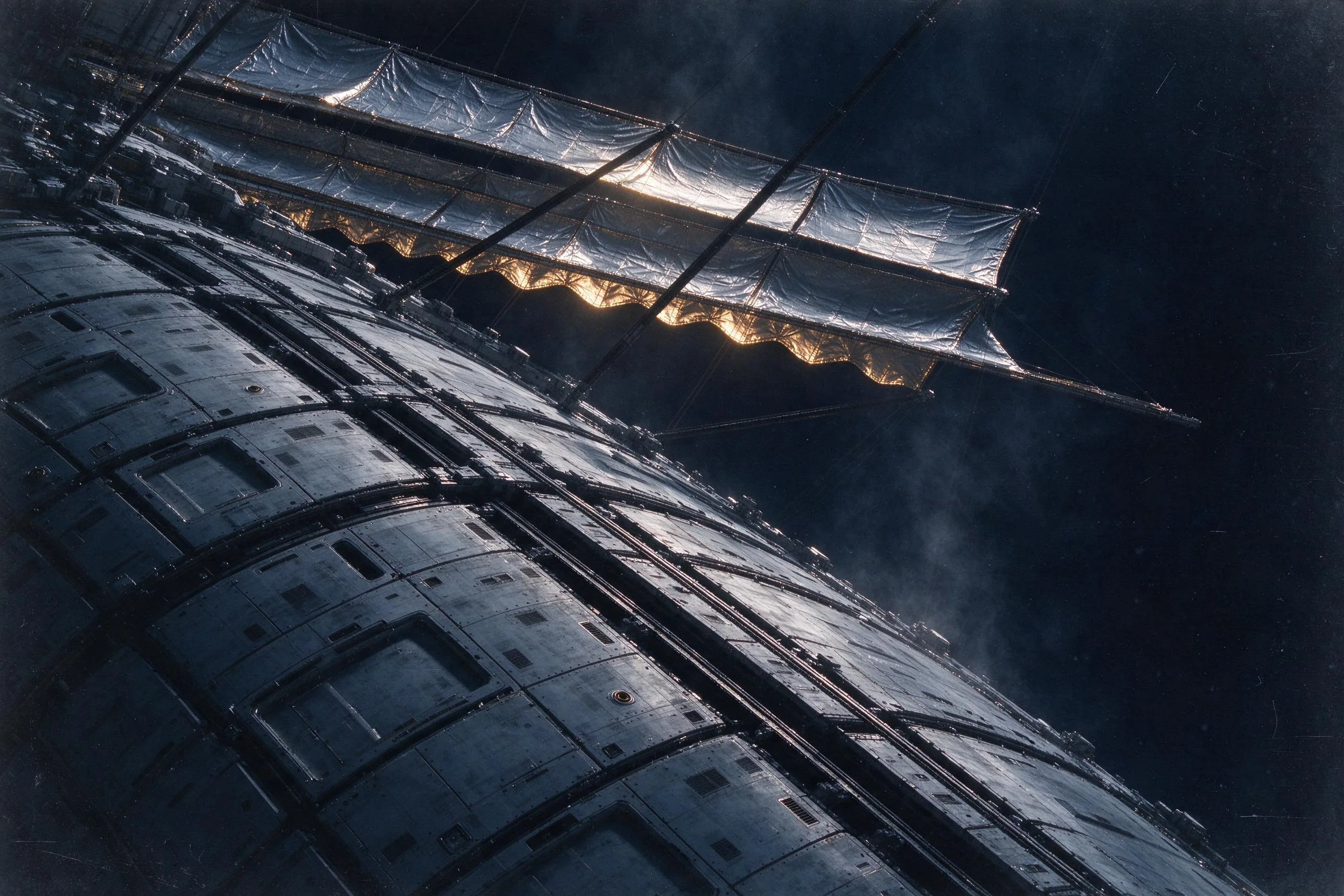
10向阳面与背阳面:尺度换来的永久阴影图 P1Photo 1遮阳帆背后,是这座站里最冷、也最值钱的那面墙Behind the sunshield lies the coldest, and most valuable, wall on the stationSunlit face and shadow face: permanent shade bought with scale
这是三区架构里最被忽略、也最物理的一条。Of everything in the three-zone architecture, this is the most overlooked and the most physical.
10.1轨道选择Orbit choice
黎明-黄昏太阳同步轨道(高度 550–800 km,倾角约 97–98°):太阳方向与轨道面几乎平行,全年几乎没有地影。结果是:A dawn-dusk sun-synchronous orbit (550–800 km, inclination about 97–98°) keeps the Sun almost parallel to the orbital plane, so for most of the year there is no eclipse at all. The result:
站体做对日定向之后,一面永远朝阳,一面永远背日;With the station held Sun-pointing, one face is permanently sunlit and the other permanently shadowed;
光伏挂阳面,辐射板挂阴面;photovoltaics on the lit face, radiators on the dark one;
辐射板永远不看太阳,也(通过朝向设计)不看地球。这是深空辐射器能拿到的最好条件。the radiator never sees the Sun and, with the right attitude, never sees Earth. That is the best condition a deep-space radiator can get.
With the station held Sun-pointing, one side faces the Sun permanently and the other never does.
Photovoltaics go on the lit side; radiators go on the dark side.
The radiator never sees the Sun, and with the right attitude never sees Earth either. That is the best condition a deep-space radiator can get.
10.2尺度是前提Scale is the precondition
站位Station class
需要阳面Needs a sunlit face
需要阴面Needs a shadow face
结论Verdict
10 MW 纯光伏10 MW, solar only
4.4 ha(210 m × 210 m)
1.2 ha(110 m × 110 m)
横截面两百米级Cross-section on the order of 200 m
10 MW 光电各半10 MW, half solar half nuclear
2.2 ha(150 m × 150 m)
0.6–1.2 ha
横截面百米级,与 ISS 桁架(109 m)同量级Cross-section on the order of 100 m — same class as the ISS truss (109 m)
kW 级小卫星kW-class small satellite
—
—
没有两个面可分,只有一套姿态No two faces to divide — only one attitude
「向阳面 / 背阳面」不是设计出来的,是长出来的。 一颗 3 米的小卫星只有「这一面朝太阳」;一座 150 米的站才有「这一侧永远朝太阳」。A sunlit face and a shadow face are not designed. They grow. A three-metre satellite has one side facing the Sun. A hundred-and-fifty-metre station has one whole side that never does.
这条是「必须大」的第五条理由,也是前面四条(面积、距离、吞吐、维护)之外最物理的一条:This is the fifth reason the station has to be large, and the most physical of the five, after area, distance, throughput and maintenance:
尺度买到的不是功率,是「同时拥有两种物理条件」的资格。
Scale does not buy power. It buys the right to hold two physical conditions at once.
10.3附带的好处:地影期变成可计算量A bonus: the eclipse becomes a number
普通低轨(550 km)一圈约 96 分钟,最长地影 35 分钟。这段时间:A normal low orbit at 550 km takes about 96 minutes, with an eclipse of up to 35 minutes. During that window:
光伏不发电 → 靠电池、核电源或降载;no generation, so the station runs on batteries, the reactor, or reduced load;
辐射照常工作,而且更好(没有太阳入射);radiation keeps working, and works better, because nothing is lit by the Sun;
交换区此时从「接收」转为「释放」,把白天存的热放出去。the exchange zone switches from absorbing to releasing what was stored in daylight.
No generation, so the station runs on batteries, the reactor, or reduced load.
Radiation keeps working, and works better, because nothing is lit by the Sun.
The exchange zone switches from absorbing to releasing, paying back what was stored in daylight.
35 分钟的黑暗,正好是交换区容量的设计输入(第 11 节)。Those 35 minutes of darkness are exactly the design input for the exchange zone's capacity (section 11).
10.4形状:把阴影做成结构Shape: turning shade into structure
尺度给了「两个面」,形状决定这两个面的纯度。目标不是「造冷」,是造一面没有太阳、也没有地球反照的墙。Scale gives you two faces. Shape decides how pure they are. The goal is not to manufacture cold; it is to build a wall that sees neither the Sun nor the Earth's albedo.
图 2|靠几何造「冷区」:四种形状方案Fig. 2 — Making a cold zone with geometry: four shape options
方案Option
阴影是怎么来的How the shadow arises
冷区占比Cold-zone share
结构代价Structural cost
A 双翼平板A: twin flat wings
中间是遮挡区,背面永阴A blocked middle section; the back is permanently shadowed
中Medium
低,最容易做Low — easiest to build
B 伞形/锥面B: umbrella / cone
锥体背面永远没有光The cone's back never sees light
最大Largest
中,要抗太阳光压Medium — must resist solar pressure
C 柱体+遮阳帆C: cylinder + sunshield
一层膜挡在太阳和设备之间A membrane between the Sun and the equipment
大Large
低,但膜怕微流星Low — but the membrane fears micrometeoroids
D L 形自遮挡D: L-shaped self-shading
自己给自己挡光The station shades itself
小Small
最低,省材料Lowest — saves material
这不是空想,已经有实物:JWST 用 14 × 21 米的五层 Kapton 遮阳帆,把 200 kW 的太阳入射压到「不到 1 瓦」,第一层最高 383 K,望远镜本体 40 K。一块网球场大小的膜,就能造出比液氮还冷的环境。This is not speculative. JWST flies a 14 × 21 m five-layer Kapton sunshield that cuts 200 kW of solar input to under one watt, with the first layer peaking at 383 K and the telescope at 40 K. A membrane the size of a tennis court already makes an environment colder than liquid nitrogen.
冷区有两个真实用途,但有一个必须澄清的幻觉:The cold zone has two real uses, and one illusion that has to be cleared up:
它是辐射板最理想的墙面。不晒、不看地球、只对着 3 K,同样的板在这里排热最多;It is the ideal wall for a radiator: unlit, facing neither Earth nor Sun, seeing only 3 K. The same panel rejects the most heat there;
它是低温介质的天然仓库。液氮、液氢放在遮阳区,不需要额外制冷机伺候;it is a natural warehouse for cryogens — liquid nitrogen and liquid hydrogen sit in the shade without a refrigerator;
⚠️ 冷区不是热沉。 真空没有热容,「冷」不会替你吸热,它只是让辐射板站在一个更好的位置。这一点必须自己先说,否则会被「热二定律」一枪打死。⚠️ A cold zone is not a heat sink. Vacuum has no heat capacity; cold does not absorb your heat, it only lets the radiator stand in a better place. This has to be said first, or the second law will finish the argument in one shot.
It is the ideal wall for a radiator: unlit, facing neither Earth nor Sun, seeing only 3 K. The same panel rejects the most heat there.
It is a natural warehouse for cryogens. Liquid nitrogen and liquid hydrogen sit in the shade without a refrigerator.
A cold zone is not a heat sink. Vacuum has no heat capacity. Cold does not absorb your heat; it only lets the radiator stand in a better place.
还有一条反向的坑:遮阳帆挡住太阳的同时,不能把自家散热面挡住、也不能让各面互相照射。自遮挡设计做不好,就变成自加热。One trap runs the other way: the sunshield must not shade the station's own radiators or let surfaces irradiate each other. Get self-shading wrong and it becomes self-heating.
11交换区:一座站内的「人工海洋」The exchange zone: an artificial ocean inside a station
地球的海洋和大气不消灭热,它们把热摊开。摊成一天、摊成一个大陆、摊成不同深度。交换区要做的就是这件事,只是尺度小得多、介质可控得多。Earth's oceans and atmosphere do not destroy heat. They spread it, across a day, across a continent, across depth. The exchange zone does the same job at a much smaller scale, with a much more controllable medium.
图 5|交换区的四道工序Fig. 5 — The exchange zone's four operations
11.1四道工序Four operations
工序Operation
手段Approach
关键数Key figures
收Collect
多回路热总线,把各区各温度的热分别汇入(不混温)A multi-loop heat bus that gathers each zone's heat by temperature without mixing
10 MW 分 4–6 条回路;氨 / 丙烯 / 液态金属10 MW split across 4–6 loops; ammonia / propylene / liquid metal
缓Buffer
相变 / 热化学 / 冷库,把尖峰摊到平均Phase change / thermochemical / cold store to spread peaks into the average
见下表See table below
提Lift
吸收式热泵、热化学压升(用高温㶲驱动,不用电)Absorption heat pump, thermochemical pressure rise (driven by high-temperature exergy, not electricity)
45 → 120 °C,面积降 2.3 倍45 → 120 °C, area falls 2.3×
交Hand over
高温板(背阳面)、排质(峰值)、随产品带走High-temperature panel (shadow face), mass venting (peaks), leaving with the product
75 °C 1,190;700 K 19,400 W/m²
11.2温度梯级:越往下越难排The temperature ladder: the lower the rung, the harder it is
图 4|温度梯级:越往下越难排Fig. 4 — Temperature ladder: the lower the rung, the harder it is to reject
交换区真正的工作,是不让热掉到最底下那一级。每往上一级,辐射面积按 T⁴ 打折:The real work of the exchange zone is keeping heat from falling to the bottom rung. Every step up discounts the radiator area by T⁴:
从From
到To
面积变化Change in area
45 °C
75 °C
12,055 → 8,407 m²(−30 %)
45 °C
120 °C
12,055 → 5,170 m²(−57 %)
45 °C
400 °C
12,055 → 602 m²(−95 %)
11.3缓冲容量:地影期与削峰Buffer capacity: eclipse and peak shaving
结论:热化学储热按质量最省,但 TRL 最低;水最重但最稳、最多用途;冰和液氢的单位质量容量最高,而它们恰好是地月物流的现成货物(第 14 节)。Conclusion: thermochemical storage is the lightest by mass and the lowest in TRL. Water is heaviest but safest and most useful. Ice and liquid hydrogen hold the most per kilogram, and they happen to be exactly what cislunar logistics already carries (section 14).
11.4介质库:按「每公斤能吸多少热」排The medium library, ranked by heat absorbed per kilogram
介质Medium
吸热Heat absorbed
性质Property
用途Use
水汽化Water vaporisation
2.6 MJ/kg
可逆,产蒸汽Reversible; produces steam
首选,也能驱动吸收式First choice; can also drive absorption cooling
月壤熔融Regolith melting
1.2 MJ/kg
不可逆,但产出氧与金属Irreversible, but yields oxygen and metal
有产品,热不白吃Produces a product — the heat is not wasted
CaCO₃ → CaO + CO₂
1.78 MJ/kg
可逆,最经典的化学储热Reversible; the classic chemical heat store
需要避免 CO₂ 环境Must avoid a CO₂ atmosphere
CaO + H₂O → Ca(OH)₂
1.4 MJ/kg
可逆,NASA 1992 年就为月基做过Reversible; NASA studied it for lunar bases in 1992
300–400 °C 温区300–400 °C band
2NH₃ → N₂ + 3H₂
2.7 MJ/kg
可逆,产氢Reversible; produces hydrogen
可回供推进剂Can feed back into propellant
MgH₂ → Mg + H₂
2.9 MJ/kg
可逆,储氢兼储热Reversible; stores both hydrogen and heat
质量最优之一One of the best per unit mass
CH₄ + H₂O → CO + 3H₂
12.9 MJ/kg
不可逆于本循环,产合成气Irreversible in this cycle; yields syngas
能接化工链Connects to the chemical chain
两条硬边界(这一点必须自己先说出来):Two hard limits, stated before anyone else says them:
不可逆的热沉会吃材料。 一年 365 天 × 100 t = 3.6 万吨,比整站还重。所以只能用可逆的(CaO、氨、氢化物)或就地取材的(月壤、水冰)。An irreversible sink eats material. 365 days at 100 t a day is 36,000 t, larger than the station itself. So you can only use reversible media (CaO, ammonia, hydrides) or media you dig up on site (regolith, ice).
「吃掉」如果没有产品,就等于用货运换散热,只是把问题搬回地球。浪费可以,浪费质量不行。Absorbing heat without producing anything is just paying freight to move the problem back to Earth. Waste is acceptable; wasting mass is not.
An irreversible sink eats material. Three hundred and sixty-five days at 100 t a day is 36,000 t, larger than the station itself. So you can only use reversible media (CaO, ammonia, hydrides) or media you dig up on site (regolith, ice).
Absorbing heat without producing anything is just paying freight to move the problem back to Earth. Waste is acceptable. Wasting mass is not.
11.5关于「制冷」About refrigeration
必须说清一件事,否则整个架构会被热力学第一定律打回来:One thing has to be said plainly, or the whole architecture gets rejected by the first law of thermodynamics:
制冷不是散热。 制冷机把热从一个地方搬到另一个地方,并且自己额外产热。它不能消灭热。
Refrigeration is not cooling. A chiller moves heat from one place to another and generates extra heat while doing it. It cannot destroy heat.
制冷的合法用途只有三件事:Refrigeration has exactly three legitimate uses:
制造局部低温环境(实验、生命保障、低温泵、超导),这是服务,不是排热,而且净产热;making a local cold environment — instruments, life support, cryopumps, superconductors. That is a service, not heat rejection, and it is a net heat source;
把热缓存进冷介质(月冰、液氢),真收益,但要有冷源;buffering heat into a cold medium — lunar ice, liquid hydrogen. A real gain, but it needs a cold source;
提温(把 45 °C 抬到 75–120 °C):机械热泵是亏的,见下表。lifting the temperature from 45 °C to 75–120 °C: a mechanical heat pump loses money at this, as the table below shows.
Making a local cold environment: instruments, life support, cryopumps, superconductors. That is a service, not heat rejection, and it is a net heat source.
Buffering heat into a cold medium: lunar ice, liquid hydrogen. Real, but it needs a cold source.
Lifting the rejection temperature. A mechanical heat pump loses money at this, as the table below shows.
机械热泵提温的账(10 MW 废热,从 45 °C 出发,卡诺值 × 45 %):The mechanical heat pump ledger (10 MW of waste heat, starting at 45 °C, Carnot × 45%):
目标Target
COP
需电Electricity needed
省下辐射面积Radiator area saved
若电来自光伏需新增Extra solar area if the power comes from photovoltaics
净结果Net result
45 → 75 °C
5.2
1.91 MW
2,038 m²
6,383 m²
净亏 4,344 m²Net loss 4,344 m²
45 → 120 °C
2.4
4.24 MW
4,694 m²
14,131 m²
净亏 9,437 m²Net loss 9,437 m²
45 → 200 °C
1.4
7.28 MW
7,797 m²
24,266 m²
净亏 16,469 m²Net loss 16,469 m²
45 → 400 °C
0.85
11.7 MW
10,749 m²
39,065 m²
已不成立No longer viable
温升越大,COP 崩得越快;T⁴ 的收益永远追不上。The bigger the lift, the faster the COP collapses. The T⁴ gain never catches up.
正确的那条路是它的反面:The correct route is the opposite one:
不要用电把已经产生的低品位热泵上去;要让热从源头就产生在高温。
Do not spend electricity pumping already-generated low-grade heat upwards. Make the heat hot where it is produced.
冶炼、制氧、裂解本来就要在 1,200–1,600 °C 工作,它们的废热天生就是高品位:一分电都不花,只要把回路接到交换区的高温一支上。这才是「交换区」真正的价值:它把热按温度分流,而不是把热消灭。Smelting, oxygen extraction and cracking already run at 1,200–1,600 °C. Their waste heat is high-grade by birth, and costs not a single watt to obtain: you only have to route the loop to the high-temperature branch of the exchange zone. That is the real value of the exchange zone. It sorts heat by temperature instead of trying to erase it.
12水的三态:一份现成的太空冷却剂The three states of water: a coolant you already have
图 9|水在真空里的三态循环Fig. 9 — The three-state cycle of water in vacuum
水进真空会同时沸腾和冻结:表面闪蒸把潜热带走 → 剩下的水急速降温 → 结冰;蒸汽在真空中膨胀,一部分再凝结成冰晶。这不是猜想,宇航员在舱外挤水袋时就见过。Water entering vacuum boils and freezes at the same time: the surface flashes off and carries the latent heat away, the remainder chills and freezes, and the vapour expands and partly re-condenses as ice crystals. This is not speculation; astronauts have watched it happen with a water bag outside the airlock.
相变Phase change
吸热Heat absorbed
工程形态Engineering form
液态 → 气态(汽化)Liquid → gas (vaporisation)
2.5 MJ/kg
蒸发器Evaporator
固态 → 液态(融化)Solid → liquid (melting)
0.33 MJ/kg
—
固态 → 气态(升华)Solid → gas (sublimation)
2.83 MJ/kg
升华器(阿波罗、舱外服液冷服用过)Sublimator (used on Apollo and in EVA suit cooling)
这是单位质量排热密度最高的手段之一,比任何实心板都强一个数量级。而且水的另一重身份是:它同时是氧、氢、饮用水和推进剂的原料,排掉的水不算全浪费,它是代谢的一部分(第 14 节)。That makes it one of the highest heat-rejection densities per kilogram available, an order of magnitude better than any solid panel. Water is also oxygen, hydrogen, drinking water and propellant stock. What you vent is not entirely wasted; it is part of metabolism (section 14).
边界必须先说清:The limits have to come first:
连续排 10 MW = 每天 332 吨水,站会被自己吹干;Venting 10 MW continuously costs 332 tonnes of water a day; the station would dry itself out;
回收要靠冷凝面,而冷凝面自己又要辐射散热:闭式循环做不到零成本,只能低损耗;recovery needs a condenser, and the condenser needs its own radiator: a closed loop is low-loss, never lossless;
所以水升华的正确位置是峰值与应急,不是基荷。so sublimation belongs in peaks and emergencies, not in baseload.
Venting 10 MW continuously costs 332 tonnes of water a day. The station would dry itself out.
Recovery needs a condenser, and the condenser needs its own radiator. A closed loop is low-loss, never lossless.
So sublimation belongs in peaks and emergencies, not in baseload.
The question of freezing water and later recovering it is, in engineering terms, sublimation plus condensation recovery. It works, but it is not free: the heat you take out of the water still has to go to a radiator in the end.
13核能:不是补充,是第二个温度源Nuclear: not a supplement, a second temperature source
「太阳能产能不够」这个判断对,但解决它的方式不止一种,而且两种解决方式在物理上是不同的东西。The judgement that solar cannot supply enough power is correct, but there is more than one way to fix it, and the two ways are physically different things.
1 kWe 全套 400 kg;10 kWe 全套 1,500 kg ⇒ 2.5 / 6.7 W/kg;连续 10–15 年;2018 年完成地面核试验(TRL 5);月面 10 kWe 演示排在 2020s 末1 kWe system 400 kg; 10 kWe system 1,500 kg ⇒ 2.5 / 6.7 W/kg; 10–15 years continuous; ground nuclear test completed 2018 (TRL 5); a 10 kWe lunar demo is scheduled for the late 2020s
NASA NTRS 20180000691/20180007389
能,但只够 kW–百 kW 级。按 150 kg/kWe 放大到 12 MWe = 1,800 t,淘汰Yes, but only for kW to hundreds of kW. Scaled at 150 kg/kWe to 12 MWe it becomes 1,800 t — eliminated
MW 级 NEPMW-class NEP
NASA 1.9 MWe 研究:4 台 500 kWe 超临界 CO₂ 布瑞顿,转换器共 2,100 kg;辐射器 375–550 K 排 4 MWtNASA 1.9 MWe study: four 500 kWe supercritical CO₂ Brayton units, 2,100 kg of converters; radiators at 375–550 K reject 4 MWt
NASA NETS-2021
10 MW 站真正要对标的那一档The class a 10 MW station is really benchmarked against
在研/在排In development / scheduled
俄 Zeus 核拖船 500 kWe 级(2030s);中俄月面核电源 2033–2035 已排期Russia's Zeus nuclear tug, 500 kWe class (2030s); the China–Russia lunar nuclear power source is scheduled for 2033–2035
ANS 2026-10
说明这不是孤例Shows this is not an isolated case
屏蔽距离Shielding distance
SNAP-8:两台 600 kWt 堆装在 61 m 长臂末端、夹角 30°、乘员舱 74 m、拦 60° 阴影角;屏蔽理想化 16 t、工程化 18.6 tSNAP-8: two 600 kWt reactors on 61 m booms at 30°, crew cabin at 74 m, blocking a 60° shadow angle; shielding 16 t idealised, 18.6 t as engineered
NASA 19720009960
「屏蔽靠距离、距离靠尺度」有精确出处“Shielding by distance, distance by scale” has a precise source
13.1一个必须承认的权衡A trade-off that has to be admitted
光伏输在面积,核输在质量。Solar loses on area. Nuclear loses on mass.
路线Route
面积Area
质量Mass
废热温度Waste-heat temperature
10 MW 光伏10 MW solar
4.4 ha
66–127 t
60–80 °C(难排)60–80 °C (hard to reject)
10 MW 核(15–25 kg/kWe)10 MW nuclear (15–25 kg/kWe)
≈0(解绑)≈0 (decoupled)
150–250 t + 屏蔽150–250 t + shielding
700–900 K(好排 20–40 倍)700–900 K (20–40× easier to reject)
所以核电源不是「更轻的方案」,它是「用质量换面积,同时把废热变好排」的方案。它的价值在三个自由度,不在公斤数:So nuclear is not the lighter option. It is the option that trades mass for area and makes the waste heat easier to reject at the same time. Its value lies in three degrees of freedom, not in kilograms:
面积解绑。功率不再由展开面积决定(这一条直接救掉了第 4 节那个 4.4 ha);Power decoupled from deployed area — this alone rescues the 4.4 ha in §4;
温度上移。废热 700–900 K,10 MW 只要 93–346 m²;Waste heat at 700–900 K, where 10 MW needs only 93–346 m²;
朝向解绑。不看太阳就不怕地影,第 10 节的「永阳/永阴」分区也有了冗余。Attitude decoupled from the Sun, so eclipse no longer threatens the lit/shadow split of §10.
Power decoupled from deployed area, which rescues the 4.4 hectares in section 4.
Waste heat at 700–900 K, where 10 MW needs only 93–346 m².
Attitude decoupled from the Sun, so eclipse no longer threatens the lit/shadow split.
而它的第四条价值,是本文最想强调的:只有核电源能在站内提供 900 K 级的「高温㶲」。第 11 节那个「吸收式/热化学提温」需要一个高温热源:光伏站没有这个东西,所以它只能用机械热泵(亏);核电站有,所以它能用热化学把 45 °C 的废热「化学地」提到 400 °C。And the fourth value is the one this document most wants to make: nuclear is the only thing on board that can supply 900 K class exergy. The absorption and thermochemical lifting in section 11 needs a high-temperature source. A solar station does not have one, which is why it is stuck with mechanical heat pumps and their losses. A reactor does, which is why it can lift 45 °C waste heat to 400 °C chemically.
所以「上核电」的真正理由,一半是发电,一半是给交换区提供一个高温热源。
So the real reason to go nuclear is half generation and half the gift of a high-temperature source to the exchange zone.
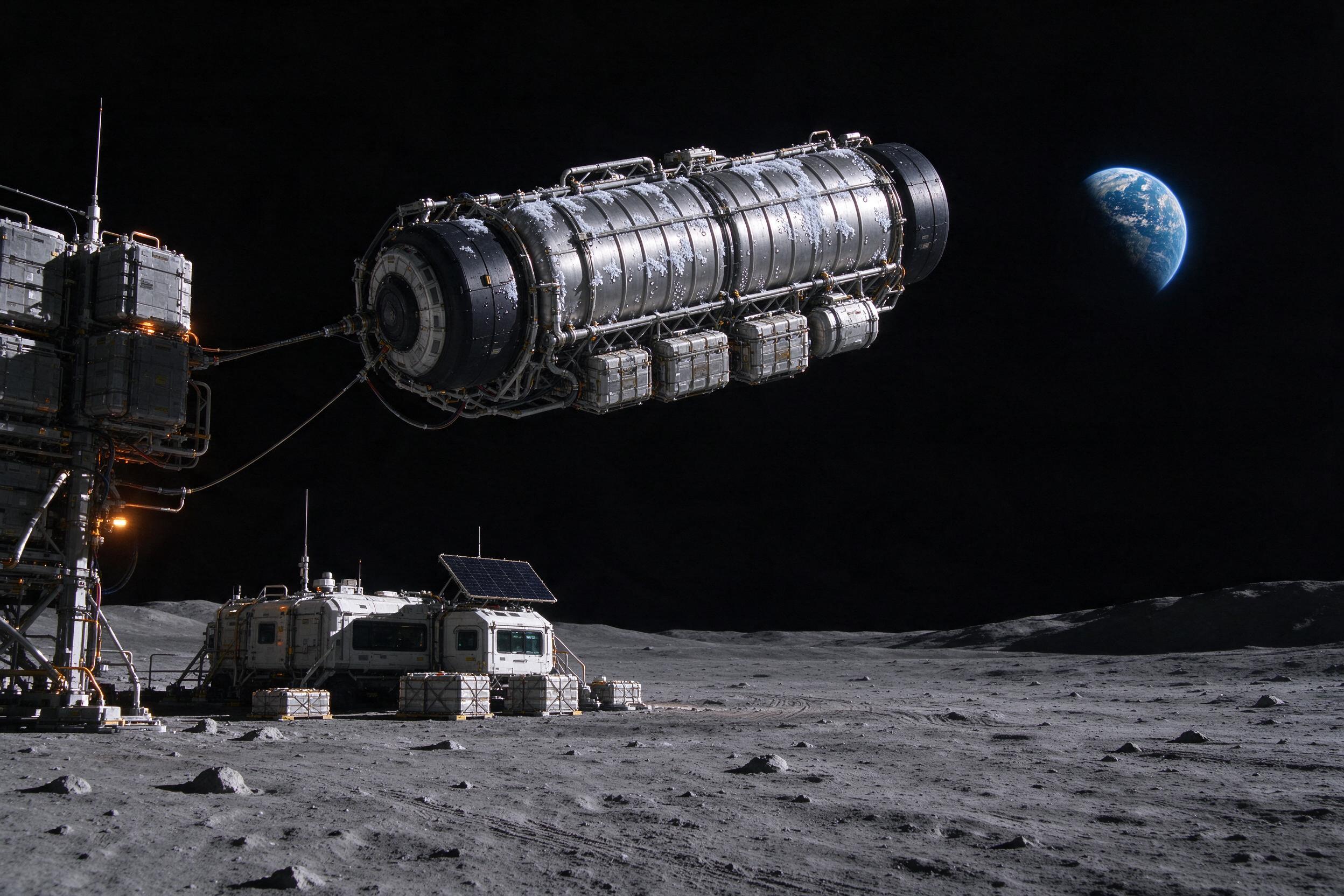
14损耗补什么:水、氢、制冷剂,与地月物流图 P2Photo 2月球的冰不是补给品,是可以运的冷量Lunar ice is not a consumable; it is cold that can be shippedWhat replaces the losses: water, hydrogen, refrigerants, and cislunar logistics
三区在稳态下是闭合的,但闭合不等于无损。损耗有四种,补给各有其道。The three zones are closed in steady state, but closed is not lossless. There are four kinds of loss and four kinds of resupply.
相变材料循环老化、热化学床中毒Phase-change material cycling fatigue, thermochemical bed poisoning
更换床体Replace the bed
地球(低质量、高价值)Earth (low mass, high value)
泵功与热机做功Pumping power and heat-engine work
回路泵、压缩机Loop pumps, compressors
电(不是质量)Electricity (not mass)
光伏/核Solar / nuclear
14.1优先级(按「一举几得」排)Priority, ranked by how many problems one shipment solves
月冰:一块 100 t 的冰,每公斤吸热约 3.16 MJ(40 K 冰 → 100 °C 蒸汽)⇒ 100 t 冰 = 317 GJ = 10 MW 跑 8.8 小时。同一批冰同时是:冷量 + 水 + 氧 + 推进剂原料。付的是运输费,拿到四样。Lunar ice: 100 t of ice absorbs about 3.16 MJ per kilogram (40 K ice → 100 °C steam) ⇒ 100 t = 317 GJ = 10 MW for 8.8 hours. The same ice is cold, water, oxygen and propellant feedstock. You pay freight and receive four things.
水:最稳、无毒、可循环,显热容量低但工程最成熟。Water: the steadiest, non-toxic, fully recyclable medium, with low specific heat but the most mature plumbing.
氢:每吨 4.45 GJ,质量最优;而且「把热倒进推进剂」是最省的一条:推进剂是唯一一种「本来就要消耗」的质量,热随质量走了,而那份质量的账本来就要付。Hydrogen: 4.45 GJ per tonne, the best per kilogram, and pouring heat into propellant is the cheapest route of all — propellant is the only mass you were going to spend anyway.
专用制冷剂:只用于局部低温回路,不参与大规模储热。Specialty refrigerants: for local cryogenic loops only, never for bulk storage.
Lunar ice. One hundred tonnes absorbs about 3.16 MJ per kilogram, so 100 t holds 317 GJ, which is 10 MW for 8.8 hours. The same ice is cold, water, oxygen and propellant feedstock. You pay freight and receive four things.
Water. The most stable, non-toxic, fully recyclable medium, with low specific heat but the most mature plumbing.
Hydrogen. 4.45 GJ per tonne, the best per kilogram, and the cheapest way to move heat is to pour it into propellant, the only mass you were going to spend anyway.
Specialty refrigerants. For local cryogenic loops only, never for bulk storage.
14.2地月物流:把「冷」变成货物Cislunar logistics: turn cold into cargo
地球→LEO ≈ 9.5 km/s;LEO→月面 ≈ 6.7 km/s;月面→地月空间只要 2.4 km/s(逃逸 2.38,无大气,重力 1/6)。Earth to LEO ≈ 9.5 km/s; LEO to the lunar surface ≈ 6.7 km/s; the lunar surface back to cislunar space only 2.4 km/s (escape 2.38, no atmosphere, one-sixth gravity).
月面工厂需要的两条输入,正好是这座站的两条出口:热和电。The two inputs a lunar plant needs are exactly the two outputs of this station: heat and electricity.
月面没有大气:电磁质量驱动器把 1 kg 加速到 2.4 km/s 只要 2.9 MJ;10 MW 按三成效率换算,每小时能甩出三吨多。With no atmosphere, an electromagnetic mass driver needs 2.9 MJ to throw one kilogram at 2.4 km/s. At 10 MW and 30% efficiency that is over three tonnes an hour.
Earth to LEO is about 9.5 km/s; LEO to the lunar surface about 6.7 km/s; the lunar surface back to cislunar space only 2.4 km/s.
The two inputs a lunar plant needs are exactly the two outputs of this station: heat and electricity.
With no atmosphere, an electromagnetic mass driver needs 2.9 MJ to throw one kilogram at 2.4 km/s. At 10 MW and 30% efficiency that is over three tonnes an hour.
热在这里不是余量,是运力。 这一条和「工艺热」是同一件事的两个方向:都在给热重新定价。
Here heat is not surplus. It is lift capacity. This and process heat are two directions of the same idea: both of them reprice heat.
边界要说清:极区水冰有多少、什么形态、采不采得出来,还在勘测(NASA 十余条取水路线在 TRL 4–6,VIPER 尚未完成巡视);月尘磨损没有长期数据;月夜 14 天、−173 °C,任何液体回路先得让自己不冻住。这些是留给专业团队的问题清单,不是构想成立的前提。The limits, stated plainly: how much polar ice exists, in what form, and whether it can be extracted is still being surveyed (NASA has a dozen extraction routes at TRL 4–6 and VIPER has not finished its traverse); there is no long-term data on dust abrasion; lunar night lasts 14 days at −173 °C, and any liquid loop has to keep itself from freezing first. These are questions for specialist teams, not preconditions for the idea.
14.3液氮:好冷源,坏热沉Liquid nitrogen: good cold source, bad heat sink
图 7|制冷剂:越冷 ≠ 越能搬热Fig. 7 — Refrigerants: colder does not mean more heat moved
冷媒Refrigerant
沸点Boiling point
每公斤吸热Heat absorbed per kg
该用在哪Where to use it
液氦Liquid helium
4 K
~0.02 MJ/kg
只用于传感器级,绝不用于排热Sensor level only — never for heat rejection
液氢Liquid hydrogen
20 K
~0.55 MJ/kg
顺便当推进剂,一物两用Doubles as propellant
液氮Liquid nitrogen
77 K
0.43 MJ/kg
低温泵、生物样本、超导、局部热冲击Cryopumps, biological samples, superconductors, local thermal shocks
主力热沉,最稳最便宜The workhorse heat sink — steadiest and cheapest
一句话:液氮是很好的「冷源」,是很差的「热沉」。 每公斤只吸 0.43 MJ,是水的六分之一;而且在地面液化它本身还要耗掉大量电(卡诺效率只有 40–50 %)。所以它应该用在「点」。把某个设备冷到 −196 °C;不该用在「面」。去排 10 MW 的废热。In one sentence: liquid nitrogen is an excellent cold source and a poor heat sink. It absorbs only 0.43 MJ per kilogram, a sixth of water, and liquefying it on the ground already burns a great deal of electricity (Carnot efficiency 40–50%). So use it at a point, to chill one instrument to −196 °C, and never across a surface, to reject 10 MW of waste heat.
还有一条:长期靠消耗冷媒是不成立的。 ESA 的结论很清楚:消耗型冷媒寿命有限,真正长久的是机械制冷(斯特林 + 冷头)。所以正确的配比是:机械制冷做基荷,消耗冷媒做尖峰与应急。One more thing: consumable coolant is not a long-term answer. The ESA position is clear that expendable cryogens limit mission life and that mechanical cooling, Stirling plus cold heads, is what lasts. The right split is mechanical refrigeration for baseload, consumables for peaks and emergencies.
14.4一座站也有代谢A station has metabolism too
把它当成一个活的东西看,比当成一堆设备更容易想清楚:Thinking of it as a living thing is easier than thinking of it as a pile of equipment:
水、氢、冷媒、备件 ← 地球与月球Water, hydrogen, coolant, spares ← Earth and the Moon
「代谢物」这个词很好用:站不该被设计成「一次性吃饱」的容器,而应该被设计成有代谢、有补给线的系统。这也直接决定了它必须是中转站:没有补给线的站,代谢一次就死了。Metabolite is a useful word here. A station should not be designed as a container that eats once, but as a system with metabolism and a supply line. Which is precisely why it has to be a transfer station: a station without a supply line dies after one metabolic cycle.
14.5下一站:月球The next stop: the Moon
如果站够大、能当中转,那么数据站落在月球就不是幻想,而是物流的下一步:If the station is large enough to act as a transfer point, then putting a data centre on the Moon stops being fantasy and becomes the next step in the logistics:
图 6|地月物流:冷是货物,站是中转Fig. 6 — Cislunar logistics: cold is cargo, the station is the transfer point
已经有人在做:Lonestar Data Holdings 走的是「月球 → L4/L5 拉格朗日点 → 熔岩管」三步,L4/L5 每 90 天才进阴影 4 小时。Someone is already doing it. Lonestar Data Holdings takes a three-step route: lunar surface, then L4/L5, then lava tubes. L4/L5 spends only four hours in shadow every ninety days.
月球的两个天然优势:极区永久阴影区低到 −173 °C;熔岩管内部常年约 −20 °C。这个温度正好是电子设备最舒服的工况,而且月壤本身就是免费的辐射屏蔽。Two natural advantages: permanently shadowed polar regions at −173 °C, and lava tubes at a steady −20 °C, comfortable for electronics, with regolith as free radiation shielding.
⚠️ 但「月球凉快」是第二个幻觉:月球一样没有空气,散热照样只能靠辐射(IEEE Spectrum 在 2026 年 1 月专门更正过这一点)。月球给你的不是「免费散热」,是更低的背景温度 + 更长的夜 + 现成的屏蔽。⚠️ But “the Moon is cool” is the second illusion: there is no air there either, so rejection is still radiative (IEEE Spectrum corrected this point in January 2026). What the Moon gives you is not free cooling, but a lower background temperature, a longer night, and ready-made shielding.
So the order is: prove the three zones and the exchange zone in low orbit, let a lunar base supply cold cargo and feedstock, and only then put a data centre on the surface. Skip the middle step and a lunar station is just a more expensive radiator.
15能量收支表:60 MW 里的 49.5 MW 去哪了The energy ledger: where 49.5 of 60 MW goes
这是本文最硬的一张表。任何工程师都认这个:入必须等于出。This is the hardest table in the document. Every engineer accepts its premise: input must equal output.
图 3|能量去哪了:59.5 MW 里的 49.5 MWFig. 3 — Where the energy goes: 49.5 MW of 59.5 MW
15.1稳态(10 MW 光伏站,黎明-黄昏轨道,正午)Steady state (10 MW solar station, dawn-dusk orbit, local noon)
项Item
数值Value
去向Destination
太阳入射到光伏面Solar input to the array
43,700 m² × 1,361 W/m² = 59.5 MW
—
转成电Converted to electricity
10 MW
供算力与工艺Powers compute and process heat
光伏未转换的余量The unconverted remainder in the array
49.5 MW
从板的两面辐射掉(板温 60–80 °C,薄板两面都散热)Radiated from both faces of the panel (60–80 °C; a thin panel radiates from both sides)
算力与工艺用电Electricity used for compute and process heat
10 MW
全部变成 10 MW 热(45–75 °C 回水)All becomes 10 MW of heat (45–75 °C return water)
这 10 MW 的处理How the 10 MW is handled
工艺热 2.5 + 暂存 1.5 + 外排 5.2 + 转电 0.8(低温热转电必亏;高温热另算,见 6.3)Process heat 2.5 + buffered 1.5 + rejected 5.2 + converted to power 0.8 (converting low-grade heat always loses; high-grade heat is separate, see §6.3)
见下See below
15.2结论一:站上 83% 的热来自光伏本身Finding one: 83% of the heat on board comes from the array itself
49.5 / 59.5 = 83%。49.5 / 59.5 = 83%.
而这部分热不需要额外设备。它是光伏板的工作方式,板本身就是个大辐射面(背面朝深空)。And that heat needs no extra equipment. It is how a panel works; the panel is already a large radiator, with its back face to deep space.
热没有变少,变的是它的出口。 而出口的温度和分流方式,正是交换区的工作。The heat does not shrink; its exit changes. And the temperature and split of those exits is exactly the exchange zone's job.
15.4结论三:总排放永远是 59.5 MW,这也是「能量守恒」Finding three: the total is always 59.5 MW, and that is what conservation means here
一个常见误解是「把热用掉就不用排了」。不是。入 59.5 MW,出必须 59.5 MW,只是出口分成四类:A common misconception is that using heat means not rejecting it. It does not. In is 59.5 MW and out must be 59.5 MW; only the exits divide into four kinds:
辐射(光伏背面 + 高温板)+ 排质与冷货 + 随产品带走 + 站内储存Radiation (panel backs plus high-temperature plates) + vented mass and cold cargo + heat leaving with products + storage inside the station.
15.5结论四:还有两笔容易被漏掉的电Finding four: two electricity loads that are easy to miss
制冷电耗(若用机械制冷做 17 °C 冷源)Refrigeration draw (if mechanical cooling makes the 17 °C source)
1.9–2.5 MW(19–25 %)
COP≈5,且这 1.9 MW 自己也要变成热COP ≈5, and that 1.9 MW itself becomes heat
所以站内输运不是问题,「制冷」才是第二大吃电户。 一个 10 MW 的站,如果靠压缩机维持芯片进水温度,实际电耗是 12 MW,实际排热也是 12 MW:PUE 直接从 1.0 涨到 1.2。So transport inside the station is not the problem. Refrigeration is the second largest load. A 10 MW station that uses compressors to hold chip inlet temperature actually draws 12 MW and rejects 12 MW: PUE goes from 1.0 to 1.2.
这也解释了为什么第 5.3 节那条「冷用面积买」如此重要:省掉的不是一点面积,是整个站的 20 % 电力。Which explains why the buy cold with area rule in section 5.3 matters so much. What it saves is not a bit of panel. It is 20% of the station's electricity.
守恒在这里只有一句话:你可以选它的温度、地点、时间,不能选它的数量。Conservation has exactly one sentence here: you choose the temperature, the place and the time. You do not choose the quantity.
16实验区:站上必须有一个「热物理实验室」The experiment zone: a station needs a thermal physics laboratory
这里要先承认一件事:太空热管理的经验数据极少。 今天几乎所有设计都靠地面数据外推,而地面数据的三条前提在太空全不成立(见第 17 节)。Start by admitting something: there is very little empirical data on thermal management in space. Almost every design today extrapolates from ground data, and the three premises of ground data all fail in orbit (section 17).
所以一座站如果只把热管理当「工程问题」,它一定会重复踩前人的坑。它必须留一个区,专门研究「在太空里到底怎么处理能源、废热和温度」。So a station that treats thermal management as a pure engineering problem will repeat other people's mistakes. It has to keep a zone whose job is to study how energy, waste heat and temperature are actually handled in space.
实验Experiment
要回答什么Question it answers
现状Current state
微重力两相流Microgravity two-phase flow
流型、临界热流密度、干涸点Flow regime, critical heat flux, dryout point
中国空间站梦天舱已有「两相系统实验柜」China's Mengtian module already carries a two-phase system experiment rack
闪蒸/升华Flash evaporation / sublimation
真空里水/氨/氧的真实行为How water / ammonia / oxygen actually behave in vacuum
只有零散飞行经验Only scattered flight experience
近场辐射Near-field radiation
纳米间隙传热的工程化Engineering heat transfer across nanoscale gaps
只有实验室尺度Laboratory scale only
涂层退化Coating degradation
原子氧 + 紫外下 α/ε 漂移α/ε drift under atomic oxygen and UV
ISS 长期暴露数据有限Limited long-duration ISS exposure data
热电材料Thermoelectric materials
AMTEC / 斯特林在 700–1300 K 的寿命AMTEC / Stirling lifetime at 700–1300 K
地面台架为主Mostly ground test stands
液滴幕Droplet curtain
液滴在真空中的蒸发损失与回收率Evaporation loss and recovery rate of droplets in vacuum
1980s 研究后中断Research stopped after the 1980s
尘埃等离子体Dusty plasma
能否作为可调辐射介质Whether it can serve as a tunable radiating medium
实验室阶段Laboratory stage
判据:实验区占站的质量不到 5 %,但它决定剩下 95 % 怎么设计。The test: the experiment zone is under 5% of the station's mass and decides how the other 95% is designed.
这不是「顺便搞点科研」,而是三区架构的第四个功能块。它和三区并列,因为它的产出是「规则」,不是「产品」。This is not incidental science. It is the fourth functional block of the three-zone architecture, alongside the other three, because its output is rules rather than products.
而且它有先例:梦天舱 13 个机柜里就有「两相系统实验柜」和「燃烧科学实验柜」。别人已经在做实验柜级的两相研究;我们的设想是把整座站做成一个两相系统。And there is precedent: two of the thirteen racks in the Mengtian module are a two-phase system experiment rack and a combustion science rack. Others are already doing rack-scale two-phase research. The proposal here is to make the whole station a two-phase system.
17太空原生热管理:别把地球的管道搬上来Space-native thermal management: do not ship the ground's plumbing upstairs
地球经验有三条隐含假设:Ground experience carries three hidden assumptions:
有重力 → 自然对流自动帮你搬热;Gravity, so natural convection moves heat for you;
有大气 → 可以蒸发、可以吹风、可以氧化;an atmosphere, so you can evaporate, blow air and oxidise;
一座 10 MW 的站,在红外波段是一个极亮的点。低温面 + 低发射率涂层 + 定向排放,可以让这个热扰动变得「低调」,甚至定向。A 10 MW station is a very bright point in the infrared. Cold faces, low-emissivity coatings and directional emission can make that thermal disturbance quiet, even directional.
热管理不只是工程问题,也是可探测性问题。这是把站做大之后必然出现的议题,而且它和「整站都是辐射面」这条设计原则直接冲突。越大的站越藏不住,所以它只能往「正当存在」的方向走,而不是「隐蔽」的方向。 这一点值得单独讨论。Thermal management is not only an engineering problem; it is a detectability problem. That is unavoidable once a station gets large, and it collides head-on with the principle that the whole surface radiates. The larger the station, the less it can hide, so it can only move towards being a legitimate presence rather than a concealed one. That deserves an argument of its own.
17.2最激进的一条设想:深冷区The most radical idea: a cryogenic zone
既然多层遮阳帆能把环境做到 40 K(JWST 实测),那么大站可以同时拥有一个深冷区(< 50 K)。那个区能做的是:超导器件、量子传感、低温红外探测、低温泵。If multilayer sunshields can hold an environment at 40 K, as JWST has demonstrated, then a large station can also hold a cryogenic zone below 50 K. What lives there: superconducting devices, quantum sensing, cryogenic infrared detection, cryopumps.
也就是说:数据中心和低温实验室可以是同一座站的两个面。Which means a data centre and a cryogenic laboratory can be two faces of the same station.
这才是「太空不是地球」的真正用法:不是把机房搬上去,是把只有太空才能做的事搬上去。That is the real use of space not being Earth. Not moving the server room upstairs, but moving upstairs the things only space can do.
部四分工与对象Part IVDivision of labour and customers
18为什么必须大Why it has to be large
#
理由Reason
关键数Key figures
1
发电面积:光伏是散热的 3.6 倍,面积解绑只有核能Generation area: the array is 3.6× the radiator, and only nuclear decouples it
4.4 ha vs 1.2 ha
2
距离:屏蔽、热隔离、故障隔离都要米级间隔Distance: shielding, thermal isolation and fault isolation all need metre-scale spacing
SNAP-8:61 m 臂、60° 阴影角、屏蔽 18.6 tSNAP-8: 61 m boom, 60° shadow angle, 18.6 t of shielding
3
吞吐:交换区要处理 100 t/日 级物料才有工艺热可用Throughput: the exchange zone needs ~100 t/day of material before process heat exists
2.5 MW → 180 t/日 月壤;83 t/日 水2.5 MW → 180 t/day of regolith; 83 t/day of water
4
可维护:坏了要能修,旧了要能升Maintainability: it must be repairable when it breaks and upgradable as it ages
小卫星的「维护」= 报废重发,每次故障都是一次发射For a small satellite, “maintenance” means scrapping and relaunching — every fault is a launch
5
两个物理条件:只有大站才同时拥有永阳面与永阴面Two physical conditions: only a large station has a permanently sunlit and a permanently shadowed face at once
150 m 级横截面(与 ISS 桁架同量级)150 m class cross-section (same order as the ISS truss)
差别不在对错,在资产类别。 小星座是覆盖(价值可以被数量堆出来),大站是寄存(价值要求它明天还在、还能修、还能变大)。可牺牲的资产,承载不了需要寄存的东西。The difference is not right versus wrong. It is asset class. A constellation is coverage: value can be piled up out of numbers. A station is custody: value requires that it still exists tomorrow, that it can be repaired, that it can grow. A disposable asset cannot hold something that has to be kept.
小节点是末梢神经,大站是内脏。把内脏拆成十万个末梢,得到的不是分布式,是十万份无法维护的责任。
Small nodes are peripheral nerves. A large station is an organ. Split an organ into a hundred thousand nerve endings and what you get is not distribution. It is a hundred thousand maintenance liabilities.
18.1规模不是「更便宜」,是「能不能自给」Scale is not about being cheaper. It is about closing the loop
这是「大才能算得过账」的严格版本。它不是边际成本曲线,是开关:This is the strict version of the argument that only large stations pay. It is not a marginal cost curve, it is a switch:
规模Scale
工艺热可用Process heat available
质量自给率Mass self-sufficiency
资产类别Asset class
1 MW
无(热只能排)None (heat can only be dumped)
≈0 %
消耗品Consumable
10 MW
2.5 MW @700 °C,需 180 t/日 物料2.5 MW at 700 °C, needs 180 t/day of material
10–40 %
生产设备Production equipment
20 MW+
5 MW @700 °C,需 360 t/日5 MW at 700 °C, needs 360 t/day
≈40 %
工厂Factory
100 MW
25 MW
≥70 %
城City
中间没有平滑过渡。 跨过去,热有用户、质量能自给、站的账才算得过来;跨不过去,热只能排、自给率是零、它就是一件消耗品。There is no smooth transition. Cross the line and the heat has users, the mass closes, and the arithmetic works. Fail to cross it and the heat can only be dumped, the self-sufficiency rate is zero, and the station is a consumable.
这也回答了「为什么不先做小的、慢慢长大」:Which also answers why you should not start small and grow:
小的不是大的缩小版,小的根本不在同一个物理制度里。
The small one is not a scaled-down version of the large one. It is not in the same physical regime at all.
18.2如果有人问:一百万颗卫星,不是比一座站更大吗?If someone asks: is a million satellites not bigger than one station?
这是最有力的一击,必须正面接。This is the strongest counter-argument, and it deserves a straight answer.
假设一百万颗、每颗 120 kW,总计 120 GW,是 10 MW 站的一万两千倍。听起来完胜。但把面积算出来:Take a million satellites at 120 kW each: 120 GW in total, twelve thousand times a 10 MW station. It sounds like a walkover. So work out the area:
架构Architecture
总功率Total power
辐射面积(45 °C)Radiator area (45 °C)
单点可维护Single-point maintainability
10 MW 站10 MW station
10 MW
12,055 m²
能修、能换、能拖走Can be repaired, replaced, towed away
100 万颗 × 120 kW1 million × 120 kW
120 GW
145 km²
坏了就报废A failure is scrap
12,000 座 10 MW 站12,000 stations of 10 MW
120 GW
145 km²
每座都能修Each one can be repaired
总面积一分不差。 因为辐射面积正比于功率,跟你怎么切分毫无关系。The total area is identical to the last square metre, because radiative area is proportional to power regardless of how you slice it.
所以真正被改变的不是面积,是三件事:So what actually changes is not area but three things:
可维护性:145 km² 分成一百万份,每一份坏了都不能修;Maintainability: 145 km² divided a million ways cannot be repaired a piece at a time;
冗余成本:一颗坏了损失 1/1,000,000,但「修不了」的代价是整颗报废;Redundancy cost: losing one costs 1/1,000,000, but the price of being unrepairable is scrapping the unit;
可退役性:一百万颗无法拖走,一座站可以。Decommissionability: a million units cannot be towed away. One station can.
Maintainability: 145 km² divided a million ways cannot be repaired a piece at a time.
Redundancy cost: losing one costs 1/1,000,000, but the price of being unrepairable is scrapping the whole unit.
Decommissionability: a million units cannot be towed away. One station can.
数量能堆出功率,堆不出基础设施。 这句话才是「必须大」的真正内容。
Numbers can pile up power. They cannot pile up infrastructure. That sentence is the real content of why it has to be large.
19末梢:小卫星能看和传,不能算The periphery: small satellites can see and carry, not compute
底稿里有一句话,我这一版差点丢了,现在补回来:小节点是末梢神经,大站是内脏。There is a line in the original draft that this version nearly lost, now restored: small nodes are peripheral nerves, a large station is an organ.
图 13|四层分工:末梢看和传,主干算和造Fig. 13 — Four layers of division: the periphery senses and carries, the trunk computes and builds
小卫星的价值不在算,在看和传:The value of a small satellite is not in computing. It is in seeing and carrying:
激光网状网已经是现实:Starlink V2 Mini 每星三台激光终端、单链路 200 Gbps;2025 年全网激光器超过 24,000 个;2026 起升级到 400 Gbps;V3 单星下行 >1 Tbps。Laser mesh is already real: each Starlink V2 Mini carries three laser terminals at 200 Gbps per link; more than 24,000 lasers were in service by 2025; 400 Gbps from 2026; a V3 satellite downlinks more than 1 Tbps.
真空里光速比光纤快(n = 1 对 1.47),跨洋路由的时延优势是物理给的,不是工程堆出来的。Light travels faster in vacuum than in glass (n = 1 versus 1.47), so the latency advantage on long routes is physics, not engineering.
结果:数据可以在天上走完大部分路程,再落到离用户最近的地面站。The result: most of the journey happens in the sky, and the data lands at the ground station nearest the user.
Laser mesh is already real: each Starlink V2 Mini carries three laser terminals at 200 Gbps per link; more than 24,000 lasers were in service by 2025; 400 Gbps began rolling out in 2026; a V3 satellite downlinks more than 1 Tbps.
Light travels faster in vacuum than in glass (n = 1 versus 1.47), so the latency advantage on long routes is physics, not engineering.
The result: most of the journey happens in the sky, and the data lands at the ground station nearest the user.
但小卫星算不动,原因很硬:它的辐射面积就是它自己的表面积。But a small satellite cannot compute, for a hard reason: its radiator is its own surface area.
一颗 3 m 见方的卫星,表面积约 54 m²,真正能当辐射面的一半都不到;按 830 W/m² 算,排水能力只有十几千瓦。而一颗 120 kW 的 AI 卫星,需要 145 m² 的板。A three-metre cube has about 54 m² of skin, less than half of which can serve as radiator; at 830 W/m² that rejects a dozen kilowatts. A 120 kW AI satellite needs 145 m² of panel.
所以连马斯克自己都在往大做:AI1 单星 120 kW、展开翼展约 70 m。他嘴上讲「小卫星」,手上造的是比国际空间站桁架(109 m)还长的东西。Which is why even Musk is building large: AI1 is 120 kW per satellite with a deployable span of about 70 m. He says small satellite; what he is building is longer than the International Space Station's truss, at 109 m.
层Layer
谁Who
干什么Does what
不可替代的理由Why it is irreplaceable
感知Sense
小卫星、探测器Small satellites, probes
拍摄、雷达、气象、科学Imaging, radar, weather, science
便宜、可牺牲、铺得开Cheap, expendable, widely spread
传输Carry
小卫星(激光网)Small satellites (laser mesh)
把数据从采集点搬到计算点Moving data from where it is captured to where it is computed
不需要维护、不需要人No maintenance, no crew
计算Calculation
大站The station
训练、推理、融合、存档Training, inference, fusion, archiving
只有大站有电和热管理Only the station has the power and the thermal management
The periphery can see and carry. Only the trunk can compute and manufacture. Mix the two and you get something that does neither, which is exactly the ceiling of the compute-per-satellite approach.
20服务对象:地外,不是地球Who it is for: off-world, not Earth
这是全文最重要的一次换题。This is the most important change of subject in the document.
马斯克和 Broersen 争的是一个隐含前提:这些算力是给地球上的人用的。 如果接受这个前提,太空几乎必输:Musk and Broersen were arguing over an unstated premise: that this compute is for people on Earth. Accept that premise and space loses almost every time:
方案Option
冷源Cold source
离用户Distance to user
维护Maintenance
结论Verdict
陆地数据中心Land data centre
大气/水,免费或低价Air / water, free or cheap
近Close
便宜Cheap
基准Baseline
海底数据中心Seabed data centre
海水,免费Seawater, free
沿海人口 50 %50% of the population is coastal
密封氮气,故障率仅陆地 1/8、能耗最高降 40 %(微软 Natick 实测)Sealed nitrogen; failure rate one eighth of land, energy use down up to 40% (Microsoft Natick, measured)
给地球供算力,海底比太空便宜得多For serving Earth, the seabed is far cheaper than space
近地轨道Low Earth orbit
要买Must be bought
25 ms
极难Extremely hard
只适合做边缘Suited only to the edge
必须先认这一条:把太空数据中心当成「地球的云」,它永远算不过海底。 不认这一条,后面的论证全是空的。That has to be conceded first: treated as Earth's cloud, a space data centre can never beat the seabed on cost. Without conceding it, everything that follows is empty.
但把服务对象换掉,结论整体反转:客户是地外作业者。But change who it serves and the conclusion inverts: the customer is the off-world operator.
目的地Destination
单程时延One-way latency
把数据传回地球算,行不行Can it be computed back on Earth?
近地星座LEO constellation
25 ms
能,但下行带宽远不够(V3 单星 >1 Tbps 也不够全网原始数据)Yes, but downlink capacity falls far short (even a V3 satellite at >1 Tbps cannot carry raw network data)
月球The Moon
1.3 s
勉强;机械臂遥控、实时避障已经做不到Barely; teleoperated arms and real-time obstacle avoidance are already out of reach
火星Mars
4–24 min
不行。关键决策必须本地做No. Critical decisions must be made locally
业界这句话说得最直白:「在关键时刻把计算外包给地球,是不可能的。」The industry line is blunt: outsourcing computation to Earth at the critical moment is impossible.
而这个需求已经在被真实项目推起来:And the demand is already being pushed by real programmes:
ORBITBeyond「Lunar Edge Compute」:2029 年月球南极部署,要扛 14 天月夜;ORBITBeyond's Lunar Edge Compute, scheduled for the lunar south pole in 2029, must survive a 14-day night;
NASA HPSC:辐射加固多核处理器,目标算力是当今航天计算机的 100 倍。NASA's HPSC is a radiation-hardened multicore processor aimed at 100 times today's spaceflight computers.
ORBITBeyond's Lunar Edge Compute is scheduled for the lunar south pole in 2029, and has to survive a 14-day night.
NASA's HPSC programme is a radiation-hardened multicore processor aimed at 100 times today's spaceflight computers.
还有一层反向限制:从外层空间往地球传数据,绕不过大气衰减、天气中断、频谱与落地权、地面站分布、时延抖动。「把地外数据传回地球算」本身就是浪费。你花了带宽,只换回一个更慢的答案。There is a reverse constraint too: sending data from deep space to Earth runs into atmospheric attenuation, weather outages, spectrum and landing rights, ground-station geography and jitter. Shipping off-world data back to Earth to be computed is itself a waste: you spend bandwidth and get a slower answer.
So the customer for space compute is not a user on Earth. It is the operator working off Earth. Change the question and every objection about cost-effectiveness evaporates, because nobody was ever trying to compete with the seabed.
月壤→氧/金属,水→推进剂;工艺链是否连续Regolith → oxygen/metal, water → propellant; is the process chain continuous?
城City
复制Replication
≥70 %
用自己产品扩建自己;无人维护是否可靠Expanding itself from its own output; is unmanned maintenance reliable?
第三列才是真正的 KPI:质量自给率。 这个指标是本文自定的(按「站内自产的质量 ÷ 总消耗质量」计),不是行业标准,写在这里是为了让台阶可比较,不是为了立规范。The third column is the real KPI: mass self-sufficiency. It is a metric defined here, as self-produced mass divided by total consumed mass, not an industry standard, included so the stages can be compared rather than to set a norm.
四个阶段:近地 5 MW 试验站(3–5 年)→ 20 MW 生产站(5–8 年)→ 月球轨道枢纽 → 行星际中继。每一阶段有验收线,钱没到位可以等,能力没到位不能跳。Four stages: a 5 MW test station in low orbit (3–5 years), a 20 MW production station (5–8 years), a lunar orbital hub, an interplanetary relay. Each has an acceptance line. Money can arrive late; capability cannot skip a step.
四个阶段其实有两层在同时生长:算力层和物流层。Those four stages are actually two layers growing at once: compute and logistics.
阶段Stage
算力形态Compute form
数据从哪来、到哪去Where data comes from and goes
补给来源Supply source
舱Module
无(只有载荷)None (payload only)
全部下传地球All downlinked to Earth
地球Earth
站(近地 5–20 MW)Station (LEO, 5–20 MW)
边缘推理、在轨筛选Edge inference, on-orbit triage
星座与探测器 → 站 → 地球Constellation and probes → station → Earth
地球Earth
厂(月轨枢纽)Plant (lunar-orbit hub)
训练与融合Training and fusion
站 ↔ 月面基地Station ↔ lunar base
地球 + 月球Earth + Moon
城(行星际中继)City (interplanetary relay)
地外自主决策Autonomous off-world decisions
火星/深空 → 中继 → 地球(延后可用)Mars / deep space → relay → Earth (tolerant of delay)
月球 + 小行星Moon + asteroids
判断标准只有一条:这一级的算力,是不是在为「下一级的地外活动」做准备,而不是在为地球打工。There is one test only: is the compute at this stage preparing the next stage of off-world activity, rather than working for Earth?
阶段一的验收指标只测三件事:The stage-one acceptance test measures three things only:
泵驱两相回路在真空里能不能长期不冻堵;whether a pumped two-phase loop runs in vacuum for years without freezing or trapping gas;
可展开辐射器实测 W/kg 能不能到 160 以上;whether a deployable radiator measures above 160 W/kg in practice;
一只 200 kW 级工艺热负载能不能稳定吃掉算力的热。whether a 200 kW process-heat load can stably absorb the compute's heat.
Whether a pumped two-phase loop runs in vacuum for years without freezing or trapping gas.
Whether a deployable radiator measures above 160 W/kg in practice.
Whether a 200 kW process-heat load can stably absorb the compute's heat.
判据不是成本,是可可行性。 本文不回答「这家公司什么时候能赚」,只回答「人类能不能做到」。所以台阶按能力分(能修 → 能造 → 能复制),不按价格分。The test is not cost. It is feasibility. This document does not answer when a company makes money; it answers whether humanity can do this at all. So the ladder is ranked by capability, repair, then manufacture, then replicate, not by price.
发射价只决定先后顺序:$1,500/kg 时只能做 5 MW 试验站;$250/kg 时能做 20 MW 生产站;$50/kg 时进入轨道工业带。但这三条都是「可行」,区别只是「何时可行」。 :方向由物理决定,节奏由成本决定。本文只负责前者。Launch price only sets the order: at $1,500/kg you can afford a 5 MW test station, at $250/kg a 20 MW production station, at $50/kg you enter the orbital industrial belt. All three are feasible; they differ only in when. Direction is set by physics. Pace is set by cost. This document is responsible for the first.
22路线图:八项关键技术,三项卡在关键路径The roadmap: eight technologies, three on the critical path
技术Technology
TRL
卡在哪Where it sticks
若不过关会怎样If it fails
可展开辐射器(比质量)Deployable radiator (specific mass)
6–7
3.6 → 1.5 kg/m² 的路径不确定The path from 3.6 to 1.5 kg/m² is uncertain
面积翻倍,站被迫更大Area doubles; the station is forced to grow
转向「地外专用」,规模缩小Pivots to off-world-only, at smaller scale
材料/TRL 卡住Materials / TRL stall
辐射器比质量停在 3 kg/m²Radiator specific mass stalls at 3 kg/m²
中Medium
靠核电与高温去换面积Area is bought with nuclear power and high temperature instead
发射价不降Launch price does not fall
长期停在 $1,000/kgStuck at $1,000/kg
中Medium
只做小型试验站,等下一轮Only small test stations, waiting for the next cycle
法律冻结Legal freeze
资源权属十年不定,没人敢投Resource rights unsettled for a decade; nobody dares invest
中Medium
停在近地,不去月球Stays in LEO, never reaches the Moon
一次大事故A major accident
大站被碎片击穿并有人员伤亡The station is breached by debris with loss of life
低,后果极严重Low, with catastrophic consequences
停摆 5–10 年Grounded for 5–10 years
这条路最怕的不是技术,是需求。 技术可以慢慢磨,需求不出现,就没人磨。
What this path fears is not technology. It is demand. Technology can be ground down over time; if demand never appears, nobody grinds.
部六边界Part VIBoundaries
24安全与韧性:碎片、辐射、单点Safety and resilience: debris, radiation, single points
ESA 2026 年的数字(MASTER-8 模型):The ESA 2026 figures (MASTER-8 model):
尺寸Size
数量Count
意味着什么What it means
> 10 cm
68,450 个(含 11,300 个活跃载荷)68,450 (including 11,300 active payloads)
可编目、可规避Catalogued, avoidable
1–10 cm
约 150 万个About 1.5 million
不可跟踪,且足以击穿:没有预警,没有机动,直接撞上Untrackable and lethal: no warning, no manoeuvre, straight through
1 mm–1 cm
约 2.3 亿个About 230 million
靠屏蔽Shielding
在轨物质总量Total mass in orbit
16,200 吨16,200 t
每周约一次不受控再入;4 次确认在轨碰撞About one uncontrolled re-entry a week; 4 confirmed on-orbit collisions
能量尺度:1 cm 铝球在 10 km/s 下相当于一枚手榴弹;10 cm 相当于 7 kg TNT,任何屏蔽都挡不住。 国际空间站能扛 1 cm,更大只能靠规避机动。Energy scale: a 1 cm aluminium sphere at 10 km/s carries the energy of a hand grenade; 10 cm is equivalent to 7 kg of TNT, and no shielding stops it. The ISS can absorb 1 cm. Anything larger is a manoeuvre.
对大站有三层含义:Three consequences for a large station:
迎风面积正比于碰撞概率。大站确实更显眼;Cross-section is proportional to collision probability, so a large station is more exposed;
但大站能做小卫星做不到的事:Whipple 双层壁、可更换面板、分段隔离、局部封闭;but a large station can do what a small satellite cannot: Whipple shielding, replaceable panels, compartment isolation, local sealing;
大站把风险变成维修工单,小卫星把风险变成报废。a large station turns risk into a work order; a small satellite turns risk into scrap.
Cross-section is proportional to collision probability, so a large station is more exposed.
But a large station can do what a small satellite cannot: Whipple shielding, replaceable panels, compartment isolation, local sealing.
A large station turns risk into a work order. A small satellite turns risk into scrap.
辐射方面,低轨有地磁保护,但单粒子翻转(SEU)仍然会打乱算力。这里有一个漂亮的耦合:On radiation, low orbit has geomagnetic protection, but single-event upsets still corrupt computation. There is a neat coupling here:
Water is heat sink, shielding and life support at once. If the exchange zone uses water as its medium, it is also a water wall, and the same mass pays three bills.
韧性判据:韧性 = 可维护性 × 冗余度 ÷ 单点数量。Resilience test: resilience = maintainability × redundancy ÷ number of single points.
25法律与环境:比技术更硬的约束Law and environment: constraints harder than engineering
《外空条约》(1967)第 2 条:外空(含月球与其他天体)不得由国家据为己有,无论以主权主张、使用、占领或任何其他方式。Outer Space Treaty (1967), Article II: outer space, including the Moon and other celestial bodies, is not subject to national appropriation by claim of sovereignty, by means of use or occupation, or by any other means.
《阿尔忒弥斯协定》:主张资源开采「不构成国家占有」,允许划定「安全区」;签署方约 70 余国(公开统计口径不一)。「安全区」是否构成事实上的占有,法律界仍有争议,这是它最大的软肋。Artemis Accords: resource extraction does not constitute national appropriation, and safety zones are permitted; around seventy signatories by inconsistent public counts. Whether a safety zone amounts to de facto appropriation is still contested — its weakest point.
国际月球科研站(ILRS):以中俄为主导的另一套合作框架。两套框架并存,月球治理可能分成两个体系。ILRS: a separate framework led by China and Russia. Two frameworks coexist, so lunar governance may split into two systems.
COPUOS:正在谈「空间资源活动」工作组。COPUOS: a working group on space resource activities is still negotiating.
Outer Space Treaty (1967), Article II: outer space, including the Moon and other celestial bodies, is not subject to national appropriation by claim of sovereignty, by means of use or occupation, or by any other means.
Artemis Accords: resource extraction does not constitute national appropriation, and safety zones are permitted; around seventy signatories, by inconsistent public counts. Whether a safety zone amounts to de facto appropriation remains contested, and that is its weakest point.
ILRS: a separate framework led by China and Russia. Two frameworks coexist, so lunar governance may split into two systems.
COPUOS: a working group on space resource activities is still negotiating.
对本文的含义:大站需要执照,而执照体系还没写完。这是唯一一个「技术全对也可能做不成」的原因。What this means here: a large station needs a licence, and the licence regime is not written yet. This is the one place where every technical answer can be right and the project still fails.
反过来,频谱是激光的强项:不占频率、波束极窄、难以截获。这也解释了为什么激光网状网会先于大站成熟。Spectrum, by contrast, favours lasers: no frequency allocation, a very narrow beam, hard to intercept. Which is also why the laser mesh matured before the station did.
环境侧有两笔账:The environmental side carries two bills:
问题Issue
现状Current state
大站是更好还是更坏Better or worse for a large station
光污染Light pollution
IAU 建议 550 km 以下卫星亮度暗于 7 等;Rubin 实测黄昏约 1/3 曝幅被污染、午夜约 20 %IAU recommends satellites below 550 km be fainter than magnitude 7; Rubin measured about a third of twilight exposures contaminated and 20% at midnight
更好:一座大站是一个目标,不是一万个Better: one station is a single object, not ten thousand
轨道拥堵Orbital congestion
Zero Debris Charter:90 % 后任务处置、LEO 5 年内离轨Zero Debris Charter: 90% post-mission disposal, deorbit within 5 years from LEO
更好:可拖走、可受控再入Better: it can be towed and re-entered under control
这是「必须大」的第六条理由:可退役性。 一座大站可以被拖走;一千颗小星是一千个不可回收目标。
Which is the sixth reason the station has to be large: decommissionability. A large station can be towed. A thousand small satellites are a thousand objects nobody can recover.
26经济:谁付钱Economics: who pays
本文不是商业计划,但必须回答「谁托底」,否则它只是空想。This is not a business plan, but it has to answer who underwrites it, or it stays a fantasy.
The test: judge an infrastructure by how much it lowers costs downstream, not by how much it earns. A lighthouse earns nothing, and without lighthouses there are no sea routes.
27人:无人是常态,有人是冗余People: unmanned is the norm, crewed is redundancy
10 MW 站的设计目标是无人运行;a 10 MW station is designed to run unmanned;
但三类事必须有人:非预期维修、好奇心驱动的科研、承担法律责任的决策;but three things still need people: unplanned repair, curiosity-driven research, and decisions that carry legal responsibility;
生活区只占 5–8 % 质量,但它是「锚点」:有人 = 有法律主体、有主权主张的依据、有故障处理的最后一道;the living volume is 5–8% of the mass, but it is the anchor: people mean a legal person, a basis for claims, and the last line of fault handling;
生理:低轨有地磁保护,但长期失重与累积剂量仍是硬约束,水墙可兼作屏蔽;physiology: low orbit is magnetically protected, but long-term microgravity and cumulative dose remain hard limits, and a water wall doubles as shielding;
心理:96 分钟一圈,等于一天 15 次日出,昼夜节律必须先解决。psychology: 96 minutes per orbit is fifteen sunrises a day. Circadian rhythm has to be solved first.
A 10 MW station is designed to run unmanned.
Three things still need people: unplanned repair, curiosity-driven research, and decisions that carry legal responsibility.
The living volume is 5–8% of the mass, but it is the anchor: people mean a legal person, a basis for claims, and the last line of fault handling.
Physiology: low orbit is magnetically protected, but long-term microgravity and cumulative dose remain hard limits, and a water wall doubles as shielding.
Psychology: 96 minutes per orbit is fifteen sunrises a day. Circadian rhythm has to be solved first.
判据:无人是常态,有人是冗余。 一个只能在有人时才活着的站,是实验装置,不是基础设施。
The test: unmanned is the norm, crewed is redundancy. A station that only lives when people are aboard is an experiment, not infrastructure.
部七收束Part VIIClosing
28猜想边界:这套论证会在哪里被推翻Where this argument breaks
一份构想能站住的地方,是它说得出自己会在哪里错。An idea earns its standing by naming where it would be wrong.
指标Metric
现状Current state
阈值Threshold
若达到,会怎样If reached
辐射器比质量Radiator specific mass
2.4–3.6 kg/m²
< 1.0 且不增加复杂度< 1.0 without added complexity
面积不再是主约束Area is no longer the main constraint
芯片工作温度Chip operating temperature
70 °C
> 250 °C
辐射面积降 5 倍,交换区可缩小一个量级Radiator area falls 5×; the exchange zone shrinks by an order of magnitude
太空热机比质量Space heat-engine specific mass
15–30 kg/kW
< 9
「废热变电」重新划算Waste heat to electricity pays again
空间电源比功率Space power source specific power
2 W/kg(Kilopower)
> 50
核小型化,「距离」约束放松Nuclear miniaturisation relaxes the distance constraint
选择性涂层 α/εSelective coating α/ε
—
α<0.1 且 ε>0.95α<0.1 and ε>0.95
「壳体即辐射器」成立The hull itself becomes the radiator
光伏效率Solar efficiency
22 %(新阵列)22% (new arrays)
> 35 %
发电面积不再是主约束,本文第 4 节失效Generation area stops being the constraint; §4 no longer applies
发射价Launch price
$1,500/kg
< $100/kg
大站在经济上成立A large station becomes economically viable
28.1三条我要自己先说清的反驳Three rebuttals I want to make first, against myself
「比质量 <1 kg/m² 会让小站复活」这个推论,我不同意。The inference that specific mass below 1 kg/m² would bring the small station back — I disagree.
The inference that specific mass below 1 kg/m² brings the small station back. I disagree.
比质量下降有两种来源:更好的材料(同结构更轻)会让小站复活;更复杂的系统(液滴辐射器需要液滴发生器、收集器、泵、防蒸发、姿态补偿)恰好只有大站装得起。 更轻的板和更简单的板,是两条路。Specific mass can fall for two reasons. Better material, the same structure lighter, would revive small stations. A more complex system, where a droplet radiator needs generators, collectors, pumps, evaporation control and attitude compensation, is something only a large station can afford. A lighter panel and a simpler panel are two different roads.
「700 K 的 100 m² 白拿」这个说法站不住。The claim that the 100 m² at 700 K comes for free does not hold.
The claim that 100 m² at 700 K comes for free does not hold.
700 K 的板不能用铝-氨回路(氨顶到约 70 °C,钛-水热管 350–530 K)。它需要钾热管(600–800 K 窗口)或 NaK(500–800 K),洛斯阿拉莫斯做过 1,700 K 以上、45,000 小时的寿命试验:路线明确,但 TRL 与寿命数据要另立课题。A 700 K panel cannot use an aluminium-ammonia loop; ammonia tops out near 70 °C and titanium-water heat pipes at 350–530 K. It needs potassium heat pipes, in the 600–800 K window, or NaK at 500–800 K. Los Alamos has run above 1,700 K for 45,000 hours. The route is clear; the TRL and lifetime data are a separate programme.
「核电源更轻」是错的。“Nuclear is lighter” is wrong.
The claim that nuclear is the lighter option is wrong.
见第 13 节。它是用质量换面积。在 10 MW 级,纯光伏其实更轻。See section 13. It trades mass for area. At the 10 MW scale, pure solar is actually lighter.
29写给两位To the two of them
给 MUSKTo Musk
1,300 W/m² 成立,我复核过,对应 82 °C 双面或 124 °C 单面,没有余量。分歧在后面。1,300 W/m² holds. I checked it: 82 °C two-sided or 124 °C one-sided, with no margin. The disagreement starts after that.
你自己说过:光伏 250 W/m²,帆板面积约为辐射面积的 5 倍。这句话是对的,而且比你想要说明的更多。 它意味着:一座 10 MW 站,发电要 4.4 公顷,散热只要 1.2 公顷。整场争论争的是第二大的那块面积。You said it yourself: panels do about 250 W/m², so the array is roughly five times the radiator. That sentence is right, and it says more than you meant. It means a 10 MW station needs 4.4 hectares to generate and 1.2 hectares to reject. The argument has been about the second-largest area all along.
所以真正的问题不是「能不能排」,是「这块面积能不能买到」,而面积买不到,只能靠温度和解绑。这就是核电的位置:不是能源,是面积政策。So the real question is not whether the heat can be dumped. It is whether that area can be bought, and area cannot be bought; it can only be traded away through temperature and decoupling. That is where nuclear sits: not as an energy source, as an area policy.
还有一句更直接的:就算明天发射免费,一次性卫星仍然不可维护。 成本降到零,约束也不会消失,因为它从来不在钱包里,而在三条守恒和一条可靠性里。赢的是运费,不是形态。One more, more directly: even if launch were free tomorrow, a disposable satellite would still be unmaintainable. Drive cost to zero and the constraints do not disappear, because they were never in the wallet. They are in three conservation laws and one reliability requirement. What you win is freight, not form.
给 BROERSENTo Broersen
真空是最好的隔热层,这一点完全正确:但它只管辖站壳那最后一米。A vacuum is the best insulator we have. That is entirely correct, and it governs only the last metre of the hull.
从芯片到辐射板之间,站内是液体回路:两相对流换热系数 5,000–50,000 W/m²K,而辐射等效只有 2.2 W/m²K。差三个数量级。 所以「没有介质」只影响最后一米,不影响中间那一百米。Between the die and the radiator, the station is a liquid loop: two-phase convection runs at 5,000–50,000 W/m²K, while radiation is equivalent to 2.2 W/m²K. Three orders of magnitude. No medium affects the last metre, not the hundred metres behind it.
830 W/m² 不是物理禁令,是一张账单;而这张账单可以用三样东西付:换温度(工艺热)、挪时间(交换区)、随质量走(月面冰与推进剂)。每一样都比电便宜。830 W/m² is not a prohibition of physics. It is an invoice, and it can be paid in three currencies: change the temperature through process heat, shift the time through the exchange zone, or let it leave with the mass in the form of lunar ice and propellant. Every one of them is cheaper than electricity.
两位都对了一半。合起来才是方法:先把热当成要分配的物资,再谈排放。Both are half right. Put the halves together and you have a method: treat heat as material to be allocated before talking about disposal.
30结语:从热到文明图 P3Photo 3从轨道上看,一座站只是一个小小的亮点Seen from orbit, a station is only a small point of lightClosing: from heat to civilisation
回到开头那一幕:一个人说「极不可能」,一个人说「不难」。Back to the opening scene: one says extremely unlikely, one says not difficult.
本文的答案不是站队,而是把问题往下挖了三层:The answer here is not to take sides, but to dig three layers deeper:
层Layer
争论停留在The argument stops at
真正的答案The real answer
第一层Level one
能不能排热Can the heat be rejected?
能。εσT⁴,没有争议Yes. εσT⁴ — no dispute
第二层Level two
排热贵不贵Is rejection expensive?
贵,但价格由温度决定(㶲)Yes, but the price is set by temperature (exergy)
第三层Level three
怎样才能便宜How can it be made cheap?
让热变成产品和补给,而不是废物(三区与自给)Turn heat into product and resupply rather than waste (three zones and self-sufficiency)
第四层(本文加的)Level four (added here)
这一切何时成立When does any of this hold?
只有跨过某个规模才成立(规模是开关)Only beyond a certain scale — scale is a switch
Thermal management is a discipline about boundaries. Where a station's thermal boundary is drawn, whether it can sustain itself, whether it can be repaired when it breaks: those three decide whether it is a consumable or territory.
文明的尺度,从来不是它能造多大的火箭,而是它能在多恶劣的环境里,维持一个不失控的系统。The measure of a civilisation was never how large a rocket it could build. It is what kind of uncontrolled system it can hold together in how hostile an environment.
热,是这个能力的第一次考试。Heat is the first examination of that capability.
一个能把热管好的文明,才配在轨道上留下东西。Only a civilisation that can manage its heat deserves to leave anything in orbit.
31附:数字口径Appendix: conventions and sources
量Quantity
取值与来源Values and sources
辐射净排热Net radiative rejection
45 °C 830、75 °C 1,190、82 °C 1,288、120 °C 1,934、400 °C 16,624、500 °C 28,930、800 °C 107,382 W/m²(双面、ε=0.92、扣地球红外与反照 22.4 %)45 °C 830; 75 °C 1,190; 82 °C 1,288; 120 °C 1,934; 400 °C 16,624; 500 °C 28,930; 800 °C 107,382 W/m² (two-sided, ε=0.92, net of Earth IR and albedo, 22.4%)
1,300 W/m²
对应约 355 K(82 °C)双面,或 397 K(124 °C)单面;无余量Corresponds to about 355 K (82 °C) two-sided or 397 K (124 °C) one-sided; no margin
地球入轨 ≈9.5 km/s;LEO→月面 ≈6.7 km/s;月面→地月空间 2.4 km/s;质量驱动器 2.9 MJ/kgEarth to orbit ≈9.5 km/s; LEO to lunar surface ≈6.7 km/s; lunar surface to cislunar 2.4 km/s; mass driver 2.9 MJ/kg
轨道Orbit
黎明-黄昏 SSO 550–800 km、倾角 97–98°,全年几乎无地影;普通 LEO 550 km 一圈 96 min、最长地影 35 minDawn-dusk SSO 550–800 km, inclination 97–98°, almost no eclipse year-round; ordinary LEO at 550 km has a 96 min period and up to 35 min of eclipse
主要外部依据:NASA NTRS(Kilopower / SNAP-8 屏蔽 / NEP 辐射器 / 月基热化学储热 / 高温热管)、NASA ATCS 概览(ISS EATCS 70 kW)、NASA TM-89852(液滴辐射器)、Mattick 1980(LDR 比质量)、Turyshev(2026-05,1 MW ⇒ 2,500 m² 辐射器、34–59 kg/kW)、中国空间站公开数据(梦天高温柜 1,600 °C;无容器柜 3,100 °C 钨合金;二期 T→十→干,90→180 t;太空母港与巡天共轨)、IEA《Powering Artificial Intelligence》(地面并网与水耗约束)。Main external sources: NASA NTRS (Kilopower, SNAP-8 shielding, NEP radiators, lunar thermochemical storage, high-temperature heat pipes); NASA ATCS overview (ISS EATCS, 70 kW); NASA TM-89852 (liquid droplet radiator); Mattick 1980 (LDR specific mass); Turyshev (2026-05, 1 MW → 2,500 m² radiator, 34–59 kg/kW); Chinese space station public data (Mengtian high-temperature furnace at 1,600 °C; containerless rack at 3,100 °C with tungsten alloy; phase two from T to cross to square configuration, 90 to 180 t; the spaceport concept and Xuntian co-orbital servicing); IEA, Powering Artificial Intelligence (grid connection and water constraints on the ground).
本稿是技术展望与构想,不是研究论文,也不是详细设计;数字用于建立量级,不用于投标。This is a technology outlook and a concept, not a research paper and not a detailed design. The numbers are here to establish magnitude and comparison, not for procurement.